

Intelligent Document Processing in Financial Services
Intelligent document processing in financial services: explore AI use cases, accuracy, fraud detection, compliance, and implementation.

Intelligent document processing (IDP) uses AI to classify documents, extract relevant information, validate data, and send verified results to financial systems. It helps lenders, insurers, and wealth managers reduce manual work while improving accuracy and traceability.
- IDP goes beyond OCR: It understands document types, extracts data across different layouts, validates values, and routes low-confidence results for human review.
- Financial services use cases: IDP supports loan underwriting, insurance submissions and claims, wealth management onboarding, KYC and AML checks, and payment operations.
- Validation matters: Extracted data should be checked with business rules, arithmetic, and comparisons across documents before it reaches a decision system.
- Fraud detection needs multiple checks: File metadata, visual inconsistencies, internal calculations, cross-document comparisons, and external data can help identify manipulated documents.
- Measure more than OCR accuracy: Track field-level accuracy, document-level accuracy, straight-through processing (STP), and catch rate to understand real-world performance.
- Keep human review in the workflow: Low-confidence fields and failed checks should go to reviewers, with corrections recorded and used to improve the process.
- Build in governance and security: Maintain source traceability, access controls, audit logs, model versioning, and appropriate data retention.
- Start with a focused pilot: Assess document volumes and costs, test one high-volume workflow with human review, then scale after accuracy and catch-rate targets are met.
Financial services run on documents that were never designed for machines. Loan files, bank statements, tax returns, ACORD submissions, loss runs, account transfer forms, and onboarding packs still arrive as PDFs, scans, and email attachments. Someone has to read them, re-key the numbers, and check that they add up. That same work is where AI is already running in production. At property and casualty insurers, "the top production use cases are all variations on AI reading and summarizing documents," according to Datos Insights. In mortgage lending, 61% of lenders and servicers in a 2026 industry survey already have AI extracting data from documents in production.
Intelligent document processing (IDP) is the technology behind that shift. This guide explains what IDP is, how it works, and where it pays back first across lending, insurance, wealth management, and compliance. We also cover topics most IDP guides leave out, including how to measure accuracy properly, how to catch fraudulent documents, where large language models go wrong on financial documents, and how to set up controls that will hold up in an examination.
1. What is intelligent document processing? Meaning, technology, and why it matters in finance
Intelligent document processing (IDP) is AI-powered software that reads documents of any format, identifies what each one is, extracts the data that matters, checks it, and sends it to the systems and people that act on it. It turns unstructured documents into structured, verified data.
Gartner defines IDP solutions as "specialized data integration tools that enable automated extraction of data from multiple formats and various layouts of document content." That framing is useful. A lender doesn't need a cleaner scan of a pay stub. It needs a verified income figure that the underwriting system can use and an auditor can trace to the page it came from.
Is IDP AI? The IDP technology behind it
Yes. Modern IDP combines several AI and automation technologies, each doing a different job.
- Optical character recognition (OCR) turns images of text into machine-readable characters.
- Natural language processing (NLP) understands what the text means, such as which number is the net pay and which is the year-to-date total.
- Machine learning models classify documents and learn from corrections, so accuracy improves over time.
- Large language models (LLMs) and vision-language models read layouts, tables, and context without a fixed template, and can summarize or answer questions about a document.
- Robotic process automation (RPA) and workflow tools move the extracted data into downstream systems.
Structured, semi-structured, and unstructured documents
Financial firms handle all three types, often in the same file.
Type | What it looks like | Financial services examples |
|---|---|---|
Structured | Fixed fields in fixed places | W-2s, ACORD forms, standard application forms |
Semi-structured | Same information, layout varies by issuer | Bank statements, pay stubs, loss runs, invoices |
Unstructured | Free text with no fixed layout | Broker emails, legal agreements, underwriting notes, trust documents |
Most of the manual work, and most of the trouble for older tools, comes from the last two rows.
How IDP has evolved
The first generation relied on OCR plus templates that told the software where each field sat on the page. These worked for standard forms and failed when a layout changed. The second generation added machine learning, which could classify documents and find fields across layouts, but needed large volumes of labeled examples. The current generation uses LLMs and vision-language models that understand a new document type with little or no training, combined with validation rules and human review to keep the output reliable. The next step, AI agents that act on the extracted data, is covered in section 15.
2. IDP vs. OCR, RPA, template capture, and document process automation
These terms are often used interchangeably, but each solves a different part of the problem. IDP is the only one that understands what a document says.
Capability | OCR | Template capture | RPA | Intelligent document processing |
|---|---|---|---|---|
Turns images into text | Yes | Yes | No | Yes |
Knows what type of document it is | No | Only known templates | No | Yes, across layouts |
Handles new or changed layouts | Not applicable | Breaks, needs a new template | Breaks if screens change | Adapts |
Extracts tables and handwriting | Partly | Partly | No | Yes |
Validates and reconciles values | No | Limited rules | Limited rules | Yes, with math and cross-document checks |
Scores its own confidence and routes exceptions | No | Limited | No | Yes |
Moves data into other systems | No | Limited | Yes | Yes, often with RPA or APIs |
Why OCR alone fails on financial documents: OCR reads characters but has no idea what they mean. It cannot tell gross pay from net pay or see that a table continues onto the next page, so a person still has to interpret every document.
How IDP and RPA work together: RPA repeats steps in other systems but cannot read a document it has never seen. IDP does the reading and checking; RPA, APIs, or agents do the moving. Most production setups use both.
Document process automation and similar terms: Document processing automation, automated or automatic document processing, and intelligent document automation cover any document workflow, from generating documents to routing them for signature. IDP is the part that understands incoming documents, so ask any "document automation" vendor whether it reads unfamiliar documents or only fills and routes known ones.
3. How intelligent document processing works, from intake to decision
An IDP pipeline has seven stages. The first four are what most vendors demo. The last three decide whether the output can be trusted in a regulated firm.
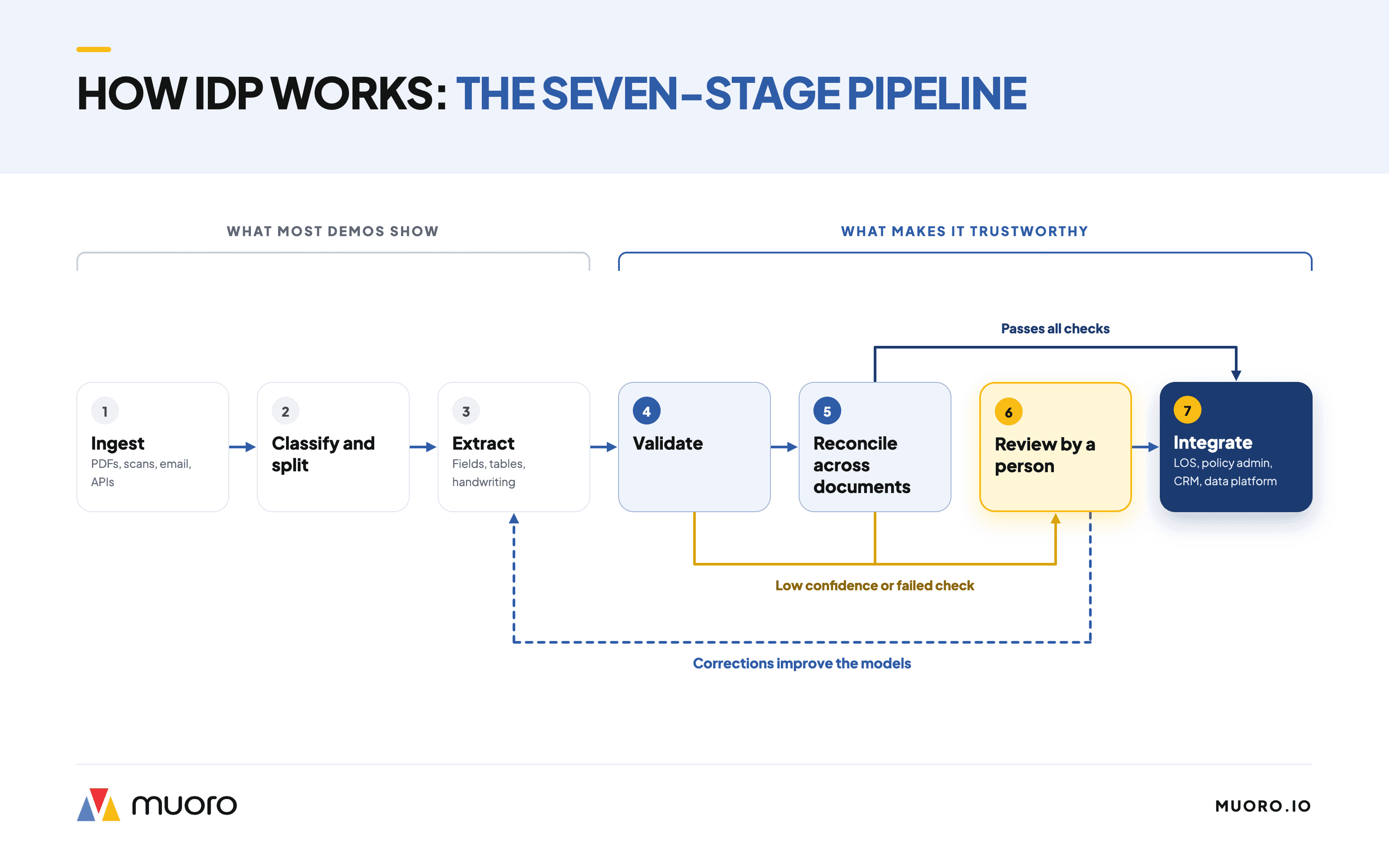
- Ingest: Documents arrive through portals, email, uploads, scanners, or APIs, as PDFs, images, spreadsheets, or native files. Images are cleaned up first: straightened, de-noised, and split into pages.
- Classify and split: Each page is identified, for example a Form 1040, a bank statement, or an ACORD 125, and a 200-page loan package is split into its separate documents.
- Extract: The system pulls the fields, tables, and entities each process needs, including multi-page tables and handwriting, and records where on which page each value came from.
- Validate: Extracted values are checked with arithmetic (do the line items add up to the total?), business rules (is the pay date in the last 30 days?), and outside data (does the company number match the registry?).
- Reconcile across documents: Values are compared between documents in the same file. Income on the pay stub should match deposits on the bank statement and wages on the W-2. A mismatch is often the first sign of an error or of fraud.
- Review by a person: Fields that fail a check or fall below a confidence threshold go to a reviewer, who sees the value next to the source page and confirms or corrects it. Corrections feed back into the models.
- Integrate: Verified data flows into the loan origination system, policy admin system, CRM, or data platform, with a link back to its source.
Reconciliation and source traceability matter most once you move past a demo. Reconciliation catches problems no single-document check would see, and traceability lets an underwriter or examiner go from any number straight back to its source page.
4. Benefits of intelligent document processing in financial services
The benefits of intelligent document processing come down to doing document-heavy work faster, more accurately, and with a better record of what happened. The economics show up in every line of business. In lending, independent mortgage companies spent an average of $11,898 to originate each loan in the first quarter of 2026, according to the Mortgage Bankers Association, and personnel makes up 67% of lenders' production costs, according to Freddie Mac. Freddie Mac also found that lenders who make heavier use of its digital underwriting tools originate loans $1,500 (14%) more cheaply and about five days faster.
In insurance, underwriters reported spending 40% of their time on administrative tasks and only 30% on underwriting itself in a survey by Accenture and The Institutes (2021). Claims show the same drag: in J.D. Power's 2026 property claims study, homeowners waited an average of 29.6 days for repairs to be completed and 40.7 days for final payment, and customers who used digital tools, such as submitting photos online, were more satisfied.
In wealth management, onboarding is the bottleneck. In F2 Strategy's 2026 survey of 36 RIAs, broker-dealers, and wealth managers, 72% named onboarding as a key source of friction. Every form that comes back not in good order adds another round trip with the client before assets can move.
In practice, cycle times shrink because loans, claims, and new accounts stop waiting for someone to read them. Cost per file falls as staff reviews exceptions instead of keying every field. Validation and cross-document checks keep re-keying errors out of pricing and credit decisions, and authenticity checks run on every file rather than only the ones that look odd. Each value carries a link to its source page and a record of who reviewed it, which makes audits far simpler. Customers are asked less often for documents they've already sent. And information that used to sit in PDFs becomes structured data that underwriting models, risk reports, and AI agents can use.
Gartner predicted in 2025 that through 2026, organizations would abandon 60% of AI projects unsupported by AI-ready data. The same research found that 63% of organizations either lack the right data management practices for AI or aren't sure whether they have them. In financial services, a large share of that data is still locked in documents, which makes IDP a prerequisite for much of the AI work firms have planned.
5. Intelligent document processing use cases across financial services
The strongest IDP use cases tend to share three traits. Documents arrive in high volumes, their layouts vary by issuer, and a decision is waiting on the data inside them.
Line of business | Documents | What IDP extracts and checks | What it feeds |
|---|---|---|---|
Lending | Pay stubs, W-2s, tax returns, bank statements, financial statements, rent rolls | Income, deposits, debts, cash flow, ratios; consistency across documents | Underwriting, spreading, covenant monitoring |
Insurance | ACORD 125, 126, and 140, loss runs, schedules of values, claims documents | Exposures, loss history, coverage details, claim amounts | Submission triage, pricing, claims handling |
Wealth and asset management | Account opening and transfer forms, trust documents, statements | Owner and beneficiary details, signatures, account numbers | Account opening, transfers, servicing |
KYC, KYB, and AML | IDs, formation documents, beneficial ownership certifications, W-8 and W-9 forms | Entity details, ownership, tax status | Onboarding, periodic reviews, screening |
Payments and operations | Dispute evidence, invoices, remittances, trade confirmations | Amounts, dates, references, counterparties | Disputes, accounts payable, reconciliation |
Lending
Lending is one of the most mature IDP use cases. In a 2026 survey of 31 mortgage lenders and servicers by the Mortgage Bankers Association, Boston Consulting Group, and state mortgage regulators (AARMR), 61% had document data extraction in production and 52% had document classification and summarization. Commercial and small business lending adds harder documents, such as multi-schedule tax returns and internally prepared financial statements, where the value comes from reconciling figures across documents and periods.
From Muoro's work. For a small business lender, our AI underwriting pipeline turns bank statement PDFs into structured data and checks them against marketplace sales, flagging gaps between reported revenue and real deposits (see section 16).
Insurance
In commercial lines, intelligent document processing for insurance starts with submissions: ACORD forms, loss runs in each carrier's format, schedules of values, and broker emails with key details in free text. In a 2026 survey of 350 commercial underwriters by hx and Coleman Parkes, 42% said manual data entry across systems slows their work. Celent's 2026 data puts document analysis and summarization (29%) and submission ingestion (20%) among the top underwriting AI uses in production. Claims is the other big opportunity, from first notice of loss to estimates, invoices, and medical bills.
Wealth and asset management
Account opening and transfer forms come back "not in good order" (NIGO) when a signature, date, or account number is missing or wrong. IDP checks them for completeness and consistency at intake, before they reach the custodian. Among the 50 large financial institutions Evident AI tracks, announced wealth management AI use cases rose from 4 to 12 in one quarter of 2026, with "document-heavy processes" the common thread.
KYC, KYB, and AML
Onboarding a corporate client means reading formation documents, ownership charts, and tax forms, then checking them against registries. In Fenergo's 2025 survey of 600 senior decision-makers at financial firms in the US, UK, and Singapore, 70% said they had lost clients in the past year to slow onboarding, and use of advanced AI in KYC and AML jumped from 42% to 82% in a year.
Payments and operations
Dispute teams read merchant and customer evidence, accounts payable teams read invoices in every format, and operations teams match trade confirmations. Accounts payable process automation is one of the most common AI uses in finance. In Gartner's 2025 survey of 183 CFOs and senior finance leaders, it had been adopted by 37% of finance functions that have implemented AI.
6. Why document AI fails on messy documents, and how to plan for it
Most document AI copes well with clean, standard files. The problems start with the messy ones, and financial firms receive plenty of those, so it pays to plan for them from day one.
Where extraction breaks
- Poor scans and phone photos: Skewed pages, shadows, low resolution, and fax artifacts.
- Complex layouts: Multi-column pages, nested tables, footnotes that change the meaning of a figure.
- Tables that span pages: A schedule of values or a list of fund holdings that runs across ten pages, with headers only on the first.
- Charts: Figures shown only in a chart. In LlamaIndex's 2026 ParseBench test of document parsers, most specialized parsers scored below 6% on extracting chart data into tables.
- Long lists: In one vendor-reported example, an extraction tool returned only 87 of 238 holdings from a 17-page fund filing. Missing rows are harder to spot than wrong ones.
- Handwriting, stamps, and signatures on forms and older records.
- Mixed packets: A single PDF holding twelve different documents in no particular order.
- Layout drift: Issuers change their statement design, and a model trained on last year's layout starts to miss fields.
How to plan for it
A few habits help. Clean up images (straighten, de-noise, and split pages) before a model ever sees them. Use table-aware parsing that keeps rows and columns together and joins tables across pages. Test with your worst documents rather than the vendor's samples. Send anything the system can't parse to a person, with the reason attached, instead of letting it guess. And track accuracy by document type and issuer, so a layout change sets off an alert before it turns into a customer complaint.
From Muoro's work. In early design testing for a corporate KYC onboarding pipeline, messy layouts, multi-column profiles, and poor scans caused extraction errors. We added automated image cleanup before files reached the language model, and set fallback paths that send unparsed paperwork to a manual review queue.
Implementation challenges beyond the documents
Legacy systems may have no clean way to receive extracted data, so integration often takes longer than extraction. Reviewers also need to trust the system enough to stop re-checking every field, and that trust is earned with measured accuracy (section 8).
7. Document fraud: catching edited and AI-generated documents
If you automate document review without checking whether the documents are genuine, you also speed up the fraud. Generative AI has made convincing fake pay stubs, bank statements, IDs, claim photos, and repair invoices cheap to produce, so authenticity checks need to sit inside the IDP pipeline instead of being bolted on afterward.
The scale of the problem
Every line of financial services is exposed, and the cost is rising.
- Insurance: Insurance fraud costs the US an estimated $308.6 billion a year, including $45 billion in property and casualty and $74.7 billion in life insurance, according to the Coalition Against Insurance Fraud (2022). AI makes it easier. In Verisk's 2026 State of Insurance Fraud study, 36% of US consumers said they would consider editing a claim photo or document, rising to 55% of Gen Z, and 13% found it acceptable to create a photo of damage that never happened.
- Wealth management: Account opening documents are the weak point. Fraudsters open accounts at one firm using stolen identity information, then pull a victim's assets across through an account transfer before the real owner knows. In August 2026, two US senators pressed FINRA over this gap, because the outgoing firm does not have to notify or authenticate the account holder before a transfer proceeds.
- Mortgage lending: An estimated 1 in 119 mortgage applications show indications of fraud, according to Cotality's September 2026 report. It notes that AI-altered documents are hard to spot one loan at a time, so lenders need to look for patterns across loans.
- Auto lending: Point Predictive's 2026 report puts auto lending fraud exposure at $10.4 billion. Income and employment misrepresentation makes up 45% of it, up 21% in a year, and fraudsters now fabricate pay records with AI.
- The cost of each loss: Every $1 of fraud now costs US financial services firms $5.47 once recovery, fees, and operations are counted, up from $4.00 in 2021, according to LexisNexis Risk Solutions. Firms estimate AI-generated techniques drive about 19% of their fraud losses.
- Forged documents: Digital forgeries made up 35% of document fraud in 2025, up from a 29% average over 2022 to 2024, according to Entrust's identity fraud report.
- The outlook: Deloitte's Center for Financial Services estimates generative AI could push US fraud losses from $12.3 billion in 2023 to $40 billion by 2027.
Regulators have noticed. In November 2024, FinCEN issued an alert on fraud schemes that use deepfake media, including fake identity documents, to get past identity verification, with red flags for financial institutions to watch.
How IDP catches document fraud
Each check below catches something the others miss, so the best results come from combining them.
- File forensics: Look at metadata, creation and edit history, and the software that produced the file. A bank statement exported from an image editor is a red flag, and so is a claim photo whose original file shows it was taken months before the date of loss.
- Visual consistency: Check fonts, alignment, spacing, and logos against known genuine versions from the same issuer.
- Internal math: Year-to-date totals should equal the sum of pay periods, running balances should follow from transactions, and invoice line items should add up to the amount claimed.
- Cross-document consistency: Net pay on the pay stub should appear as deposits on the bank statement and agree with the W-2. A repair invoice should match the estimate and the damage in the photos. Names, addresses, and signatures on account transfer forms should match the account record.
- Outside data: Compare with payroll data, bank account verification, tax transcripts, business registries, or contractor and medical provider records where available.
- Patterns across files: The same template, tax preparer, or round-number income across unrelated applications can point to an organized ring.
Automation helps mainly because it applies every check to every file. LexisNexis found firms with mainly automated fraud programs rate them 89% effective, compared with 61% for mainly manual programs.
8. How to measure IDP accuracy beyond OCR accuracy
A vendor quoting "99% OCR accuracy" is telling you how well its software reads characters. That is not the number that decides whether IDP saves your team time, or whether a wrong value slips into a credit decision. Four measures matter more.
- Field-level accuracy: The share of individual fields extracted correctly, measured per field type. Income fields and dates often perform very differently.
- Document-level accuracy: The share of documents where every required field is correct. This is what determines how many documents need no human touch.
- Straight-through processing (STP) rate: The share of documents that pass all checks and go through with no human review.
- Catch rate: Of the values that are wrong, the share the system flags for review. This is the measure that protects you most. A slightly less accurate system that reliably flags its own mistakes is safer than a more accurate one that is confidently wrong.
Why 97% field accuracy can still send half your documents to a person
Field errors compound across a document. If each field is right 97% of the time, a document with 25 fields comes out fully correct only about 47% of the time (0.97 to the power of 25). The other 53% need at least one fix.
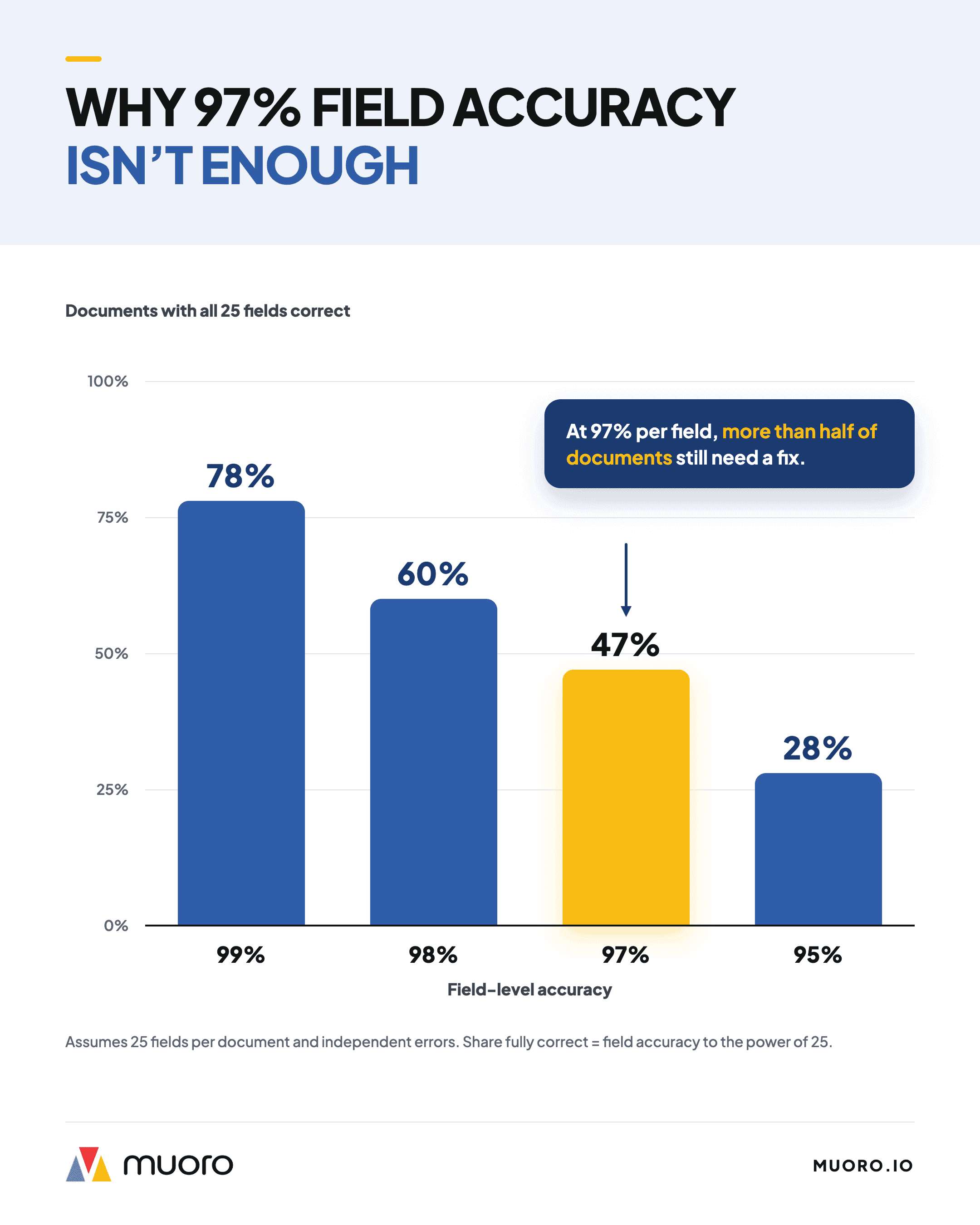
So a demo that looks impressive field by field can still disappoint in production. Catch rate makes the difference: if the system flags the wrong fields reliably, reviewers check one field instead of the whole document. If it doesn't, errors pass silently into decisions.
How to measure it properly
- Use your own documents: Build a test set from real files, including the messy ones, with answers confirmed by experienced staff.
- Measure by document type and field: An average across all documents hides the weak spots.
- Check confidence calibration: When the system says it is 95% sure, it should be right about 95% of the time. Poorly calibrated scores make thresholds meaningless.
- Keep measuring in production: Sample reviewed and straight-through documents regularly, so accuracy doesn't drift unnoticed as layouts change.
9. GenAI, LLMs, and RAG on financial documents
Large language models and vision-language models have changed AI-based document processing more than anything since OCR. They have also introduced new ways to be wrong.
What LLMs add
LLMs remove the need for templates, so a model can read a statement layout it has never seen and still find the closing balance. They pick up context, such as a footnote that changes what a figure in a table means. Underwriters and analysts can ask a 300-page file a question and get an answer with a page reference. New document types can often be added in days rather than months.
Regulators are seeing it too. FINRA's 2026 oversight report names "summarization and information extraction" as the top generative AI use case it observes at member firms.
Where they fail
- Plausible but wrong values: An LLM can produce a number that looks right and appears nowhere in the document. OCR mistakes usually look like mistakes, such as garbled characters. These don't.
- Retrieval misses: Retrieval-augmented generation (RAG) answers questions by first finding the relevant passages. On long financial documents, a common failure is that the right document is found, but the page holding the answer is missed, so the model fills the gap. On the FinanceBench benchmark of questions about public company filings, GPT-4-Turbo with a retrieval system answered 81% of questions incorrectly or refused to answer (2023 study; newer models do better, but the failure pattern remains).
- Broken tables: Splitting documents into chunks for retrieval can separate a table's numbers from its headers.
- Inconsistent output: The same document can produce slightly different results on different runs unless outputs are constrained.
How to use LLMs safely on financial documents
- Ground every answer: Require a source page and passage for each value and answer, and check that the cited text actually contains it.
- Validate outputs against a schema: Fixed field names and types, with rules for ranges and formats.
- Wrap the model in deterministic checks: Arithmetic, cross-document reconciliation, and business rules run outside the model, every time.
- Parse before you retrieve: Keep tables and page structure intact, and retrieve at page level as well as chunk level.
- Filter by access rights in the retrieval layer, so users only get answers from documents they are allowed to see.
From Muoro's work. Our document Q&A platform for policy, contract, and compliance documents applies these controls: structure-preserving parsing, grounding checks, citations, and access filters (see section 16).
10. Governance, security, and compliance for IDP in financial services
IDP handles some of the most sensitive data a financial firm holds, such as Social Security numbers, income, account numbers, and identity documents, and its output often feeds regulated decisions. That makes it a governance question as much as a technology one. No US rule is written specifically for IDP, but several existing rules apply directly.
Rule or guidance | Applies to | What it means for IDP |
|---|---|---|
Financial institutions handling customer information | Encrypt documents and extracted data, control access, oversee IDP vendors, and (for FTC-regulated firms) report security events affecting 500 or more consumers | |
FinCEN customer due diligence (CDD) and identity verification rules | Covered financial institutions, including broker-dealers, mutual funds, and depository institutions | Extracted identity and ownership data must be verified and kept on record; the March 2025 interim rule removed beneficial ownership reporting to FinCEN for US companies, but firms' own CDD duties remain |
FinCEN deepfake alert (FIN-2024-Alert004) | Financial institutions | Watch for AI-generated identity documents and report suspicious activity |
IRS tax documentation rules, including FATCA | Firms collecting W-9 and W-8 forms | Extracted tax status drives withholding and reporting, so errors carry tax consequences |
Broker-dealers | GenAI used for extraction and summarization needs testing, monitoring of inputs and outputs, vendor oversight, and recordkeeping | |
Insurers in adopting states | AI used in underwriting and claims falls under the insurer's written AI program, including vendor due diligence | |
Model risk and fair lending rules | Lenders and any firm using extracted data in credit decisions | Where extracted data feeds credit, pricing, or claims decisions, extraction belongs inside model risk and data governance; adverse action reasons are only as accurate as the data behind them |
For the full picture of what US regulators expect from AI, see our guide to AI governance in financial services.
Controls that make IDP defensible
- Source traceability: Every extracted value links to its page and position in the original document.
- Logged review: Every human correction and override is recorded with who made it and when.
- Versioning: Record which model, prompt, and rules version processed each document.
- Access control in the data layer: Reviewers and AI tools see only the documents they are entitled to see.
- Retention and deletion that follow your record-keeping obligations for both source documents and extracted data.
- Human review designed in from the start: Set confidence thresholds by risk. A misread phone number and a misread income figure do not deserve the same threshold.
Deployment choices
Where documents are processed matters to risk and compliance teams. Options include multi-tenant SaaS, a private cloud tenancy, a deployment inside the firm's own cloud account, or on-premises software. Ask where documents and extracted data are stored, whether they are used to train the vendor's models, how long they are kept, and which subprocessors, including model providers, can see them.
11. Choosing intelligent document processing solutions and vendors
There is no single best intelligent document processing solution for financial services. The right choice depends on your documents, your volumes, where data must stay, and what happens to the data next. Most "best IDP tools" lists are written by a vendor that ranks itself first, so start with the categories.
The IDP vendor landscape
Category | Examples | Strengths | Watch for |
|---|---|---|---|
IDP platforms | ABBYY, UiPath, Hyperscience, Tungsten Automation (formerly Kofax) | Broad document coverage, review interfaces, workflow, mature support | Licensing cost, fit with finance-specific documents, setup effort |
Hyperscaler services | Amazon Textract and Bedrock Data Automation, Google Cloud Document AI, Azure AI Document Intelligence | Scale, pay-as-you-go pricing, runs in your cloud account | You build the validation, review, and integration layers yourself |
Finance-specialist tools | Lending, insurance, and KYC point solutions | Pre-built models for pay stubs, tax returns, ACORD forms, and similar documents | Narrow scope; may not cover your other workflows |
Open-source tools | Tesseract, Docling, PaddleOCR | No license fees, full control, can run on-premise | Engineering effort, no vendor support, your team owns accuracy |
Custom builds on LLMs | Frontier and open-weight models with your own pipeline | Fits your exact documents, rules, and systems | Needs strong engineering, evaluation, and governance |
Analyst research can help shortlist platforms. Gartner published its latest Magic Quadrant for Intelligent Document Processing on September 8, 2026, and Everest Group publishes its own annual IDP assessment. They help with a shortlist, but they won't tell you how a product handles your documents.
Evaluation checklist
- Accuracy on your documents: Run a proof of concept on a few hundred real files, including the worst ones, and measure field accuracy, document accuracy, and catch rate (section 8).
- Tables and long documents: Test multi-page tables, schedules, and statements with hundreds of rows.
- Confidence scores and review: Check that scores are calibrated and that the review screen shows each value next to its source.
- Fraud and authenticity checks, built in or through a partner.
- Audit trail: Source traceability, logged corrections, and model versioning.
- Deployment and data handling: Where data is processed and stored, retention, and whether your documents train shared models.
- Integration: APIs and connectors for your loan origination, policy, CRM, and data platforms.
- Pricing model: Per page, per document, per field, or a platform fee. Model the cost at your real volumes, including pages that need reprocessing.
- Exit terms: Can you export your data, labels, and configurations if you switch?
Build, buy, or combine?
Buy when your documents are common types and a platform already handles them well. Build when your documents, rules, or data residency needs are specific enough that no product fits. Most financial firms end up combining: a platform or hyperscaler service for reading, with their own validation, reconciliation, fraud checks, and integration around it. In our experience, that surrounding layer affects accuracy and trust more than the choice of extraction engine.
It's also worth asking what "agentic" means in any sales pitch. Gartner warns of "agent washing," where vendors rebrand chatbots, AI assistants, and RPA tools as agents, and estimates that only about 130 of the thousands of vendors claiming agentic AI are real.
12. Implementing IDP with a readiness assessment and a phased roadmap
The safest approach is to start with one workflow, measure it, and only then scale. Firms that struggle with IDP automation have usually tried to automate every document type at once, or bought a platform before they knew where their data would go.
Readiness assessment
Answer these questions before choosing a tool.
- Volumes and types: Which documents arrive, how many a month, and in what formats?
- Current cost: How long does each document take today, and how often is work redone?
- Error and fraud exposure: Where do mistakes or fake documents cause the most damage?
- Destination: Which systems and decisions need the data, and in what structure?
- Review: Who will handle exceptions, and how fast must they respond?
- Data readiness: Do downstream systems have clean definitions for the fields you will extract?
- Constraints: Data residency, retention, vendor rules, and regulatory expectations.
A three-phase roadmap
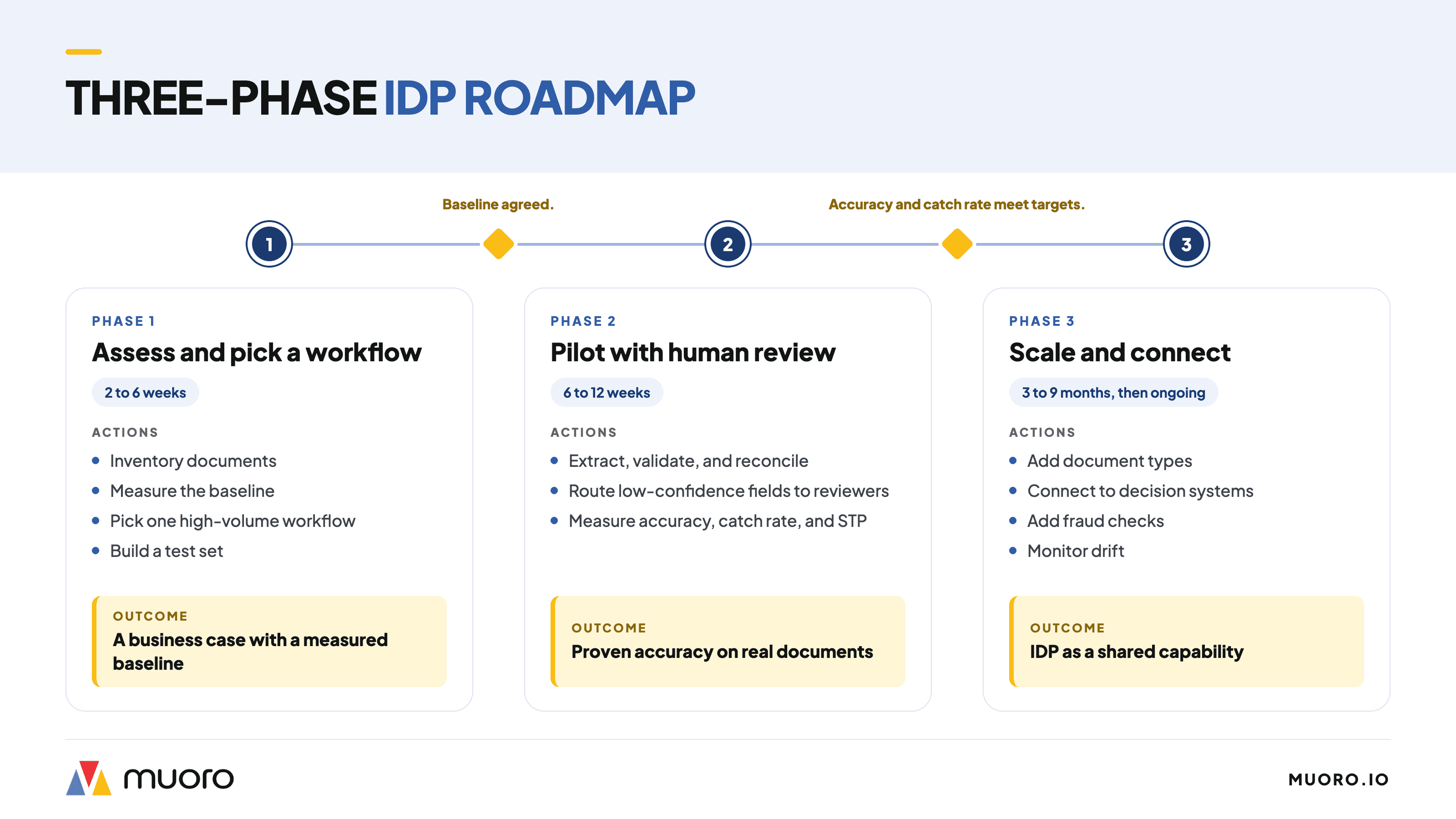
Phase | Indicative timeline | Main actions | Outcome |
|---|---|---|---|
1. Assess and pick a workflow | 2 to 6 weeks | Inventory documents, measure the current baseline, choose one high-volume workflow, build a labeled test set | A business case with a measured baseline |
2. Pilot with human review | 6 to 12 weeks | Extract, validate, and reconcile; route low-confidence fields to reviewers; measure field accuracy, catch rate, and STP | Proven accuracy on real documents, and reviewers who trust it |
3. Scale and connect | 3 to 9 months, then ongoing | Add document types and workflows, connect to decision systems, add fraud checks, monitor drift | IDP as a shared capability across lines of business |
Timelines depend on document complexity, integration effort, and how quickly reviewers can label test data.
13. Intelligent document processing best practices and common mistakes
Best practices
- Start with one high-volume workflow: Pick a process where documents are frequent, the manual cost is measurable, and the decision downstream is clear.
- Design for the messy documents: The clean 80% will work in any demo. Your results depend on the scans, long tables, and odd layouts.
- Keep people on low-confidence fields: Set a threshold for each field based on its risk.
- Reconcile across documents: Compare values between pay stubs, statements, tax forms, and applications. This catches both errors and fraud.
- Trace every value to its source: Reviewers and examiners should be able to click from a number to the page it came from.
- Check authenticity as well as content: Add document fraud checks before extracted data reaches a decision.
- Measure on production data, and keep measuring as layouts and volumes change.
- Plan where the data goes: Agree field definitions with the teams and systems that will use the data before you extract it.
Common mistakes
- Buying on demo accuracy: Vendor samples are cleaner than your documents.
- Automating review without checking documents are genuine: This speeds up fraud as well as approvals.
- Treating a prompt as a control: Telling an LLM to "only use numbers from the document" does not guarantee it will. Use grounding and validation outside the model.
- Ignoring where extracted data lands: Clean extraction into a messy data model just moves the problem downstream.
- Removing reviewers too early: Cut review only when measured catch rates justify it.
Often the biggest barriers aren't technical at all. In the 2026 MBA, BCG, and AARMR survey of mortgage firms, the top constraints on AI were regulatory uncertainty (59%) and unclear return on investment (45%). A measured pilot with a strong audit trail answers both.
14. How to measure IDP with metrics and KPIs
A short set of KPIs shows whether IDP is paying back. Track them alongside the accuracy measures in section 8 (field accuracy, document accuracy, and catch rate), and report them by document type and workflow, not as one average.
KPI | What it shows | Target direction |
|---|---|---|
Straight-through processing rate | Share of documents processed with no human touch | Rising, without a fall in catch rate |
Exception rate | Share of documents sent to a reviewer | Falling over time |
Cycle time | Time from document arrival to verified data | Falling |
Cost per document | Total cost, including review time and rework | Falling |
Rework rate | Share of files sent back to customers or brokers for documents or corrections | Falling |
Confirmed fraud flags | Flags that turn out to be genuine fraud, and the false-positive rate | More true flags, fewer false ones |
For leadership, a quarterly view is enough: documents processed, STP rate, cycle time, cost per document, catch rate, and fraud caught.
15. The future of intelligent document processing: agentic document workflows
The future of intelligent document processing is moving from reading documents to acting on them. We expect four trends to matter most for financial firms over the next two years.
AI agents take on the whole document workflow
Today, IDP extracts data and a person decides what to do next. Agents can go further: notice that a bank statement is missing a page, request it from the borrower, check a registry, and draft an underwriting note for a person to approve. Adoption is real but still early. Capgemini found only 10% of financial firms have AI agents at scale, with 80% at the idea or pilot stage. Underwriting, claims processing, loan processing, and customer onboarding are among the top processes firms name for deploying agents at scale, each cited by 59% to 68% of respondents in their sector. Nearly half (48%) are creating new roles to supervise agents.
Supervision catches up
FINRA's 2026 report flags "unsupervised execution of regulated actions by agentic AI" as an emerging risk. Expect examiners to ask which actions an agent may take on its own and which need a person. Gartner predicts that more than 40% of agentic AI projects will be canceled by the end of 2027 due to escalating costs, unclear business value, or inadequate risk controls. The projects most likely to last are the ones built on accurate, traceable document data.
Documents and data APIs coexist
Some information that once arrived as documents, such as bank transactions, now arrives through data connections. The CFPB's personal financial data rights rule under Section 1033 would expand that, but it remains under reconsideration as of August 2026. For the foreseeable future, firms will handle both: APIs where they exist, and documents everywhere else.
Data quality becomes the bottleneck
As models improve, the limit shifts to the data around them. In Cambridge's 2026 survey of 628 organizations, including fintechs, established financial firms, AI vendors, and regulators, data availability and quality was the top barrier to AI adoption, while 52% were already experimenting with agentic AI. For document-heavy workflows, IDP is where much of that data comes from.
16. Intelligent document processing case studies
Here are three projects from Muoro's work around Intelligent Document Processing.
Corporate KYC onboarding for a global financial group
The problem: Onboarding corporate clients relied on multi-step manual compliance lookups across unstructured documents and tax registries, which slowed onboarding and put data integrity at risk.
What we designed: An event-driven workflow that starts profiling as soon as a new entity enters the onboarding portal. An LLM-based extraction layer pulls entity names, registration numbers, and operating details from complex corporate files. A validation layer structures and cleans the output, and a tax validation step checks it against the FATCA registry. Image cleanup runs before extraction to handle poor scans and multi-column layouts. Any file the system cannot parse goes to a manual review queue.
What we learned: Messy layouts were the main risk, so we treated the route to a human reviewer as a core part of the design.
Multi-agent underwriting for a small business lender
The problem: A lender funding e-commerce sellers underwrote each application by hand across marketplace data and bank statements. The process was slow, inconsistent, and could miss gaps between reported sales and real cash flow.
What we built: A multi-agent underwriting pipeline. One agent converts bank statement PDFs from banks in the US, Europe, and Singapore into structured data. Others analyze marketplace sales from platforms such as Amazon, Shopify, and Walmart, match them against bank activity, and produce a master underwriting report with a proposed credit line. Guardrails ensure reports are built only from verified output, with full execution traces and cost tracking.
What we learned: Most of the value came from checking sources against each other, which is also how manipulated figures surface.
Document Q&A with source citations
The problem: Teams needed answers from policy manuals, contracts, and compliance guides stored across many repositories. Keyword search missed meaning, and a general-purpose chatbot risked inventing answers.
What we built: A retrieval-augmented generation platform that parses PDFs and Word files while keeping headers, tables, and page numbers. Answers come with clickable source citations, grounding checks flag claims not supported by the retrieved text, and access filters limit each user to documents they are allowed to see.
What we learned: Without grounding, citations, and access control, the answers wouldn't have been usable in a regulated setting.
17. How Muoro helps with intelligent document processing solutions
Muoro helps financial services firms turn documents into data they can trust and act on. We start where most IDP projects go wrong: the messy documents, the checks around the model, and where the data goes next. We work with operations, risk, compliance, data, and technology teams in four ways.
- Assess your document workflows, volumes, costs, and risks, and pick the workflow that will pay back first.
- Build extraction with validation, cross-document reconciliation, fraud checks, and human review, using the platforms, cloud services, or models that fit your documents.
- Connect verified data to governed data foundations, decision systems, and AI agents, with lineage back to the source page.
- Scale to more document types and lines of business, with accuracy monitored in production.
Frequently Asked Questions
What is intelligent document processing, in simple terms?
It is software that reads documents the way a trained person would: it works out what each document is, pulls out the information that matters, checks it, and passes verified data to the systems that need it.
What does intelligent document processing do in financial services?
It speeds up loan underwriting, insurance submissions and claims, account opening, and KYC reviews by extracting and checking the data in borrower, policyholder, and client documents, and flagging anything doubtful for a person.
Is intelligent document processing considered AI?
Yes. IDP combines OCR, natural language processing, machine learning, and increasingly large language and vision-language models, with rules and human review around them to keep results reliable.
What is the difference between OCR and intelligent document processing?
OCR converts images of text into characters without knowing what they mean. IDP uses OCR as one step, then classifies the document, finds and validates the right fields, and scores its confidence. OCR gives you text; IDP gives you checked, structured data.
What is the difference between RPA and IDP?
RPA automates repetitive steps in software but cannot read an unfamiliar document. IDP reads documents and turns them into checked data. They often work together: IDP extracts the data, and RPA or APIs move it into downstream systems.
What are the best intelligent document processing solutions for financial services?
There is no single best solution. Options range from IDP platforms and hyperscaler services from AWS, Google, and Microsoft to finance-specialist tools, open source, and custom LLM builds. Choose the one that performs on your own documents with the controls your risk team accepts.
How accurate is intelligent document processing?
It depends on the documents. Clean forms can reach very high field accuracy, but field accuracy alone misleads: at 97% per field, only about 47% of 25-field documents are fully correct. Measure document-level accuracy and catch rate on your own files.
Can IDP read handwriting, tables, and poor-quality scans?
Far better than older OCR, especially with image cleanup and vision-language models. Accuracy still drops on faint handwriting, tables that span many pages, and low-resolution images, so good systems flag these for review instead of guessing.
Which financial documents can IDP process?
Almost any, including pay stubs, tax returns, bank and brokerage statements, financial statements, ACORD forms, loss runs, claims documents, account forms, IDs, formation documents, W-8 and W-9 forms, invoices, and trade confirmations.
Can IDP detect fraudulent or AI-edited documents?
Yes, when fraud checks are built in. IDP can examine file metadata, compare fonts and layouts with genuine versions, test internal math, compare figures across documents, and spot repeated templates across applications.
Does IDP replace underwriters, analysts, or manual data entry?
It takes over most manual data entry, but not the expert work. Underwriters and analysts get more time for judgment calls and exceptions, and people are still essential for reviewing low-confidence fields, investigating fraud flags, and making regulated decisions.
How does RAG relate to intelligent document processing?
Retrieval-augmented generation answers questions by first retrieving relevant passages. If parsing loses tables and page structure, retrieval misses the right page, and the model may invent an answer, so good IDP makes RAG more reliable.
What is agentic document processing?
It uses AI agents that act on what they read, such as requesting a missing document, checking a registry, or drafting a decision for a person to approve. In financial services, agents need clear limits and a full log of every action.
How long does it take to implement IDP?
A focused pilot on one workflow typically takes 6 to 12 weeks after a short assessment. Scaling to more document types and connecting to decision systems takes several more months, and integration often takes longer than extraction.
Start your project with Muoro!
Fill out the form and our business team will reach out to you within 24 hours.
No similar blogs found for this article.
Latest Blogs
Latest Blogs


Start Building Data-First Production AI
Move beyond pilots. Build AI systems that drive real decisions and measurable outcomes.
TALK TO US