

Human-in-the-loop AI in financial services
Which AI decisions need human approval in financial services, what US regulators expect from human-in-the-loop review, and how to avoid rubber-stamp approvals.

Human-in-the-loop AI helps financial services firms maintain meaningful human oversight of AI-driven decisions. Lenders, insurers, and advisers must determine which decisions require human approval, establish effective review processes, and ensure reviewers can challenge or change AI outcomes.
- Three oversight models: Human-in-the-loop involves approving each decision, human-on-the-loop involves monitoring AI actions and intervening when needed, and human-in-command establishes limits and overall accountability.
- Regulatory expectations: Colorado SB 26-189 and California's CPPA ADMT rules emphasize meaningful human review, including reviewer authority to change decisions. Both take effect January 1, 2027.
- Decision risk assessment: Human approval should prioritize high-impact, difficult-to-reverse decisions such as loan declines, insurance claim denials, and investment recommendations.
- Prevent rubber-stamp approvals: Reviewers need decision-making authority, access to supporting evidence, sufficient review time, and independence from teams responsible for building AI models.
- Measure review effectiveness: Track override rates, second-review disagreements, time per review, decisions overturned on appeal, and errors identified through later sampling.
- Maintain review records: Document who reviewed each AI decision, when it happened, the AI recommendation, supporting evidence, the final decision, and reasons for any changes.
- Plan review capacity: Estimate review volumes, establish service levels, use sampling for lower-risk decisions, and feed human overrides back into model improvement.
- AI agent controls: Require approval gates for costly or difficult-to-reverse actions and ensure designated people can pause autonomous AI agents when necessary.
Many financial firms already keep a person close to their AI decisions. In the Bank of England and FCA's 2026 survey, 80% of UK firms answering questions on AI agents had agents in production that recommend actions while "humans decide and execute." Only 2% let agents act with broad autonomy. In the US, 48% of adviser firms have a formal policy, plan, or procedure for human-in-the-loop oversight of AI outputs, according to the IAA, ACA Group, and YCC survey.
New state rules set a higher bar for that person. California's rules, for example, ask whether the reviewer understands the AI's output, considers other relevant information, and has the authority to change the decision.
This guide to human-in-the-loop AI sets out which AI decisions at lenders, insurers, and advisers need human approval, what US rules expect from a review, and how to make that review work at scale. For the wider picture, see our guide to AI governance in financial services.
Human in the Loop, on the Loop, and in Command
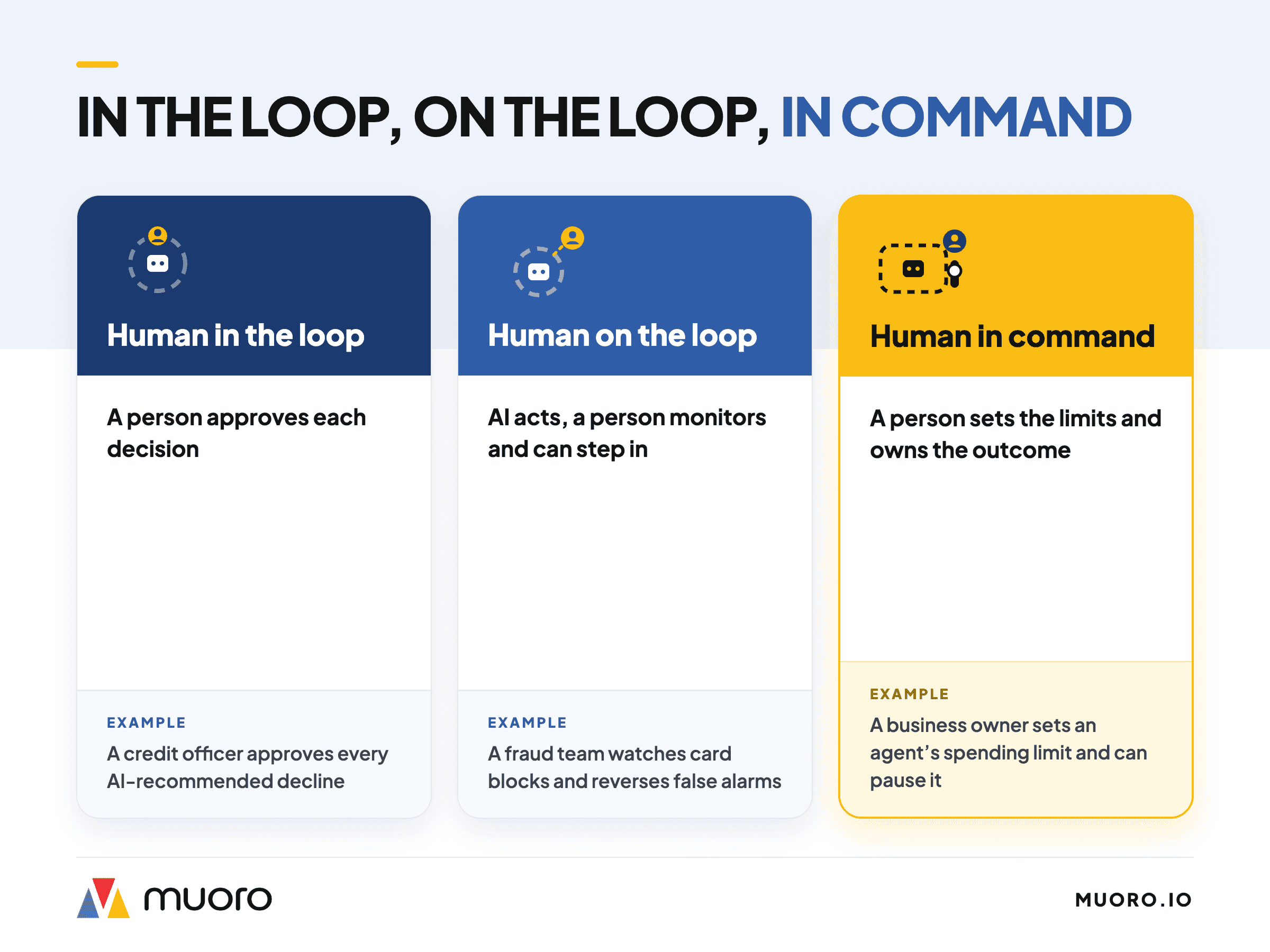
These three terms describe how much a person controls an AI decision. A firm can use all three for different decisions.
- Human in the loop. A person approves each decision before it takes effect. For example, a credit officer approves every AI-recommended loan decline.
- Human on the loop. The AI acts, and a person monitors and can step in. For example, a fraud team watches automatic card blocks and reverses false alarms quickly.
- Human in command. A person sets the limits, owns the outcome, and can stop the system. For example, a business owner sets the maximum refund an AI agent can issue and can pause it at any time.
The right model depends on the decision, which is what the rest of this guide covers.
What US Regulators Expect from Human Oversight of AI
No US rule lists which AI decisions need a person. Several now describe what meaningful human oversight of AI looks like.
Outside the US, the FCA has warned against "treating human review as a substitute for addressing weaknesses in the underlying system" (Clifford Chance). For firms with EU exposure, the EU AI Act requires high-risk systems such as credit scoring to be designed for effective human oversight, with those rules now applying from December 2, 2027 (Mondaq).
Which Decisions Need Human Approval
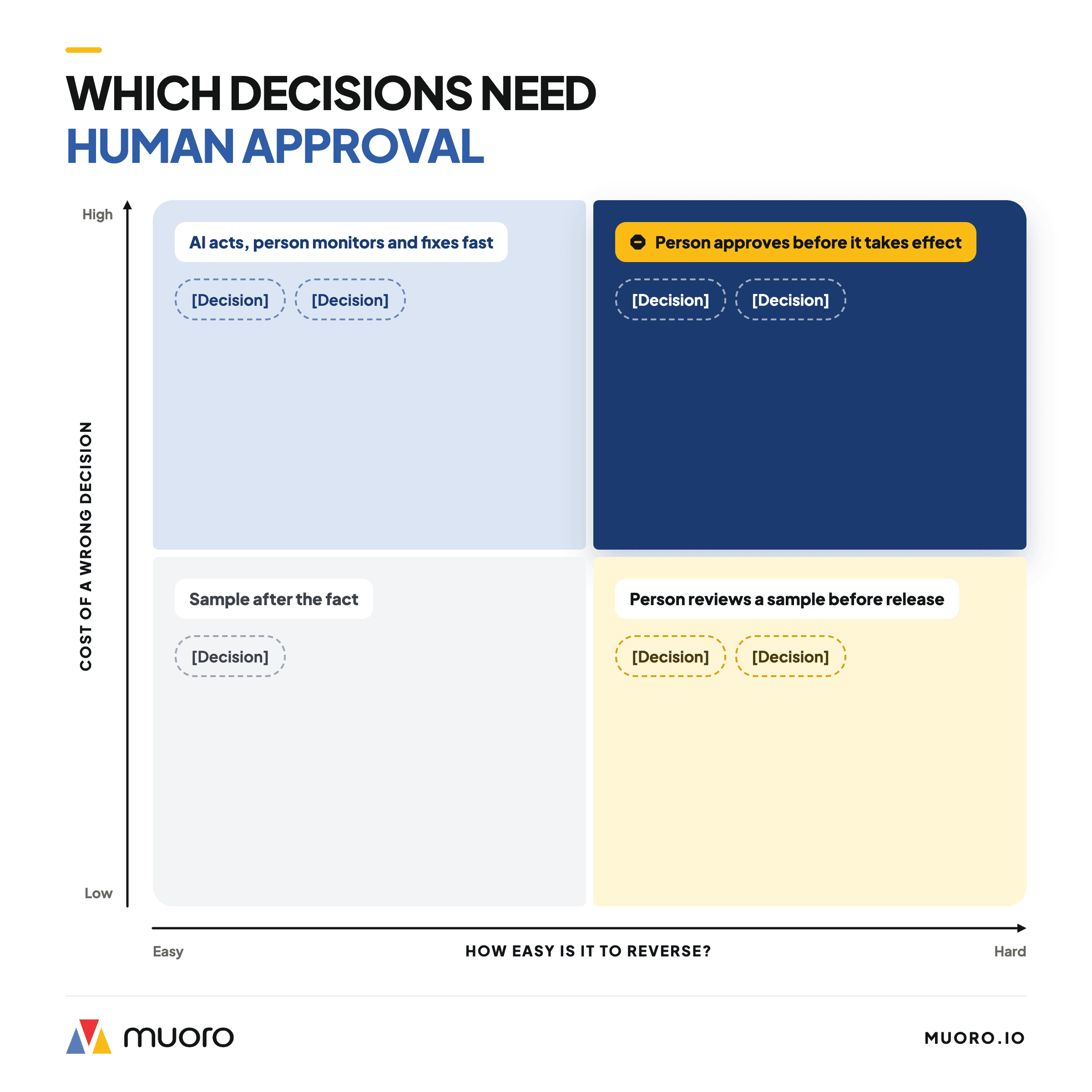
Two questions decide where a person belongs in an AI decision.
What does a wrong decision cost? Consider the customer, the firm, and the regulator. A wrongly declined loan application costs the applicant, and it can raise fair lending questions. A clumsy internal summary costs very little.
How easily can it be reversed? A card blocked by mistake can be unblocked in minutes. A loan offer sent to the wrong customer, or an investment trade, is much harder to take back.
High cost and hard to reverse means a person approves before the decision takes effect. High cost but easy to reverse means the AI can act while a person monitors and corrects quickly. Low-cost decisions can be sampled, before release if they're hard to reverse, or afterward if they're easy to fix.
Here's how that plays out for common decisions in financial services, from AI credit decisioning to customer messages. Your own answers will depend on your products, customers, and risk appetite.
Decision | Cost of a wrong decision | Easy to reverse? | Human role |
|---|---|---|---|
Loan approval or decline | High for the applicant, with fair lending exposure | Hard once communicated | A person approves declines and edge cases. Approvals inside policy can run automatically with regular sampling |
Insurance claim denial | High for the policyholder | Hard once communicated | A person approves every denial |
Fraud alert that blocks a card or payment | Medium, mainly customer friction | Easy | The AI acts, and a person monitors and handles appeals quickly |
AML transaction alert | High, mainly regulatory | Easy at the alert stage | The AI flags and prioritizes, and a human investigator decides what to escalate |
Investment recommendation to a client | High, with suitability risk | Hard once the client acts | An adviser approves it before it reaches the client |
Customer message drafted by generative AI | Medium to high if it includes a commitment, price, or disclosure | Hard once sent | A person reviews regulated content before sending, and routine replies are sampled |
Internal summary or research note | Low to medium | Easy | Sample after the fact |
How to Make Human Review More Than a Rubber Stamp
A reviewer who approves almost everything the AI suggests adds cost and very little control. The FCA has described a case where human review "became a box-ticking exercise" as reviewers accepted AI recommendations without enough scrutiny. Gradient Labs describes the same pattern from its founders' time at Monzo. A reply-suggestion tool was right about 90% of the time, and reviewers "learned to click accept, quality drifted, and efficiency barely moved" (Gradient Labs).
Review works when four conditions are met.
- Authority. The reviewer can change or overturn the decision, and doing so carries no penalty.
- Information. The reviewer sees the AI's reasons and the evidence behind them, along with the customer's file.
- Time. The reviewer's workload leaves enough time to judge each case properly.
- Independence. The reviewer isn't part of the team that built the model or the team rewarded for its speed.
"Most review screens show the AI's answer and an approve button. A reviewer also needs the reasons and the evidence behind them. Without those, approving becomes the only realistic option."
Mukul Juneja, Founding Partner & CTO, Muoro.
How to Measure Whether Human Review Is Working
Track a few numbers for each type of decision, and look at them monthly.
Measure | What it tells you |
|---|---|
Override rate | How often reviewers change the AI's decision. A rate near zero needs investigating |
Second-review disagreement | How often a second reviewer disagrees with the first, on a sample of cases |
Time per review | Whether reviewers have time to judge each case properly |
Decisions overturned on appeal | Whether reviewed decisions hold up when customers challenge them |
Errors found in later sampling | What review is missing |
Record Every Review
Log each human review alongside the AI decision. Record who reviewed it, when, what the AI recommended and why, what the reviewer saw, their decision, and their reason for any change. That record supports Colorado's adverse outcome explanations, California's access requests, and FINRA's effective practice of storing prompt and output logs. It also shows examiners the review actually happened.
Plan Review Capacity Before You Need It
At high volumes, review capacity becomes the practical constraint. At Colorado's rulemaking hearing in October, Affirm said it makes 37.8 million credit decisions a year and declines about 15% of applicants. Affirm estimated that could mean 11 human reviews a minute under Colorado's law, according to The Sum and Substance.
To plan for it, estimate review volumes from your decline or denial rates, set service levels for each decision type, and sample lower-risk decisions instead of reviewing every one. Feed reviewer overrides back to the model team as labeled examples. That kind of human feedback in AI governance can improve the model and, over time, reduce how many cases need a person.
AI Agents Need Stop Rights
Some agents act on their own instead of recommending, which changes where a person belongs. FINRA lists agents acting beyond their "intended scope and authority" among the risks firms should consider. Put an approval gate in front of any action that's costly or hard to reverse, such as moving money, changing a customer's account, or sending a commitment. Then name a person who can pause the agent, and test that they can. For who should own each stage of approval, see our AI governance checklist.
Put the Right Person in the Right Place
Not sure which of your AI decisions need a person, or whether your reviewers can change the outcome? Muoro's AI governance assessment maps your AI-influenced decisions, checks how human review works in practice, and gives you a prioritized plan to close the gaps. Book your AI governance assessment.
Frequently Asked Questions
What Does Human-in-the-Loop Mean in AI?
A person reviews and approves each AI decision or output before it takes effect. In financial services, that's usually a credit officer, claims handler, or adviser who can accept, change, or reject what the AI recommends.
What's the Difference Between Human-in-the-Loop and Human-on-the-Loop?
With human-in-the-loop, a person approves each decision. With human-on-the-loop, the AI acts while a person monitors and can step in. Many firms use both, depending on how costly and how reversible each decision is.
Can AI Make Decisions Without Human Input in Financial Services?
Yes, for many lower-risk decisions, such as routing a query or flagging a transaction. For consequential decisions like credit or claims denials, Colorado and California give consumers a route to human review, and many firms keep a person involved in the final decision.
How Do You Stop Human Review Becoming a Rubber Stamp?
Give reviewers the authority to change the outcome, the information to judge it, and the time to do it. Then track how often they override the AI, and investigate if the rate falls close to zero.
Does Every AI Decision Need Human Review?
No. Base it on what a wrong decision would cost and how easily it can be reversed. Have a person approve high-impact decisions, monitor medium-risk ones, and sample the rest.
Who Should Review AI Decisions?
Someone with the expertise to understand the output and the authority to change the decision, as California's rules require. In most firms, that person sits in the business team that owns the decision.
Start your project with Muoro!
Fill out the form and our business team will reach out to you within 24 hours.
Similar Blog Posts
Similar Blog Posts


Start Building Data-First Production AI
Move beyond pilots. Build AI systems that drive real decisions and measurable outcomes.
TALK TO US