

How Commercial Insurers Automate Submission Intake, From ACORD Forms to Loss Runs
How commercial insurers and MGAs use AI to extract ACORD forms and loss runs from broker submissions, and the checks that keep underwriting data accurate.

Most commercial insurance submissions still arrive as broker emails with ACORD forms, loss runs, statements of values, and supplementals attached. Only 9% of underwriting executives in Accenture's 2025 survey use intelligent ingestion today. This guide explains how AI submission intake works and the checks that keep extracted data accurate enough for underwriters to rely on.
- Submissions are document packages: Each file holds different facts in a different format, and an underwriter needs those facts to agree before judging the risk.
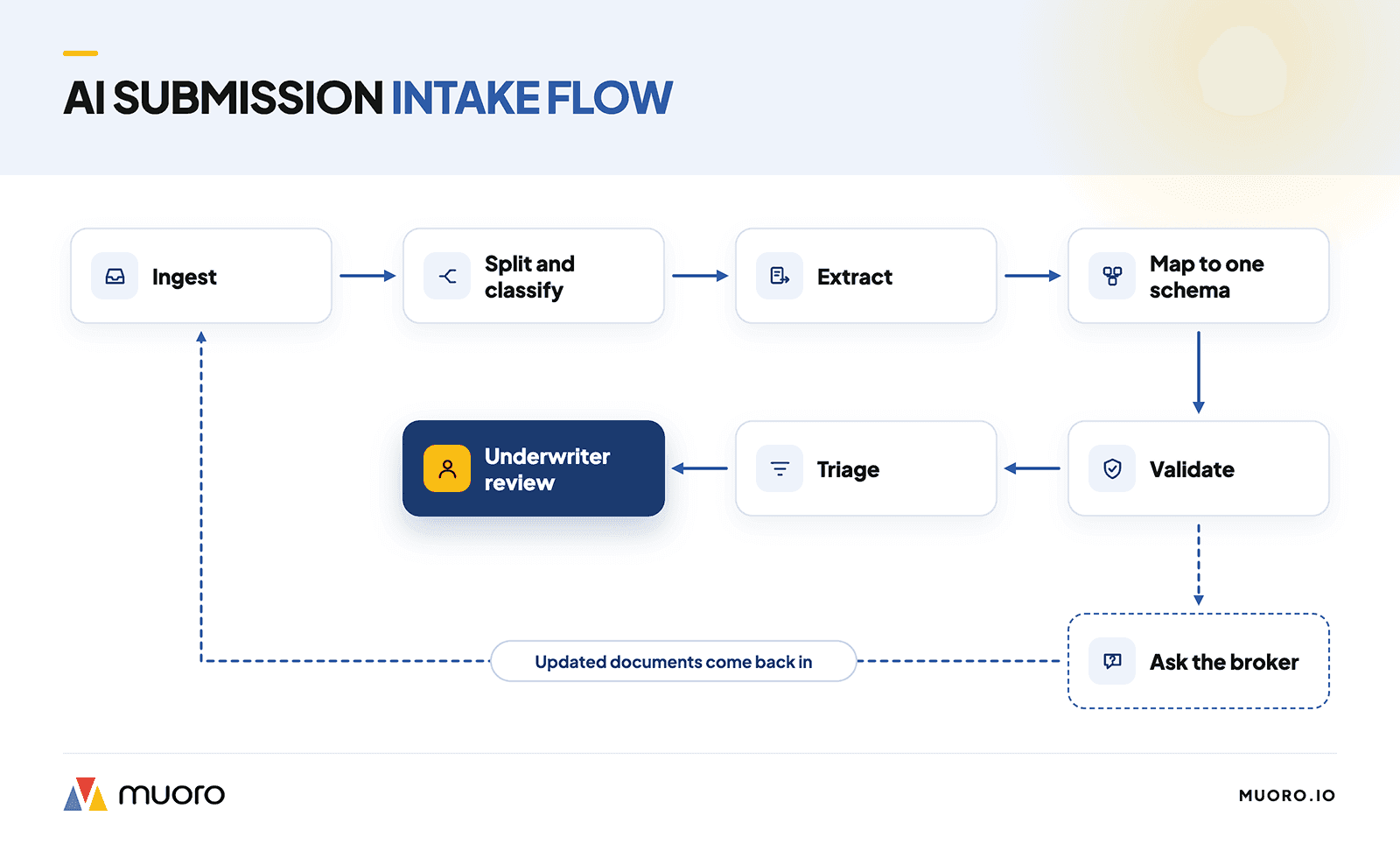
- AI intake runs in three stages: Ingest and classify each attachment, extract and map everything to one schema, then validate, triage, and hand a complete file to the underwriter.
- ACORD forms need rule checks: Form versions, scans, and checkboxes cause errors, so rules on FEINs, NAICS codes, dates, and limits flag fields for review.
- Loss runs need one set of fields: Every carrier uses its own layout and terms, so each report is mapped to standard fields such as paid, reserve, and incurred.
- Loss run arithmetic catches errors: Incurred should equal paid plus reserve, totals should match the carrier's summary, and no policy years should be missing.
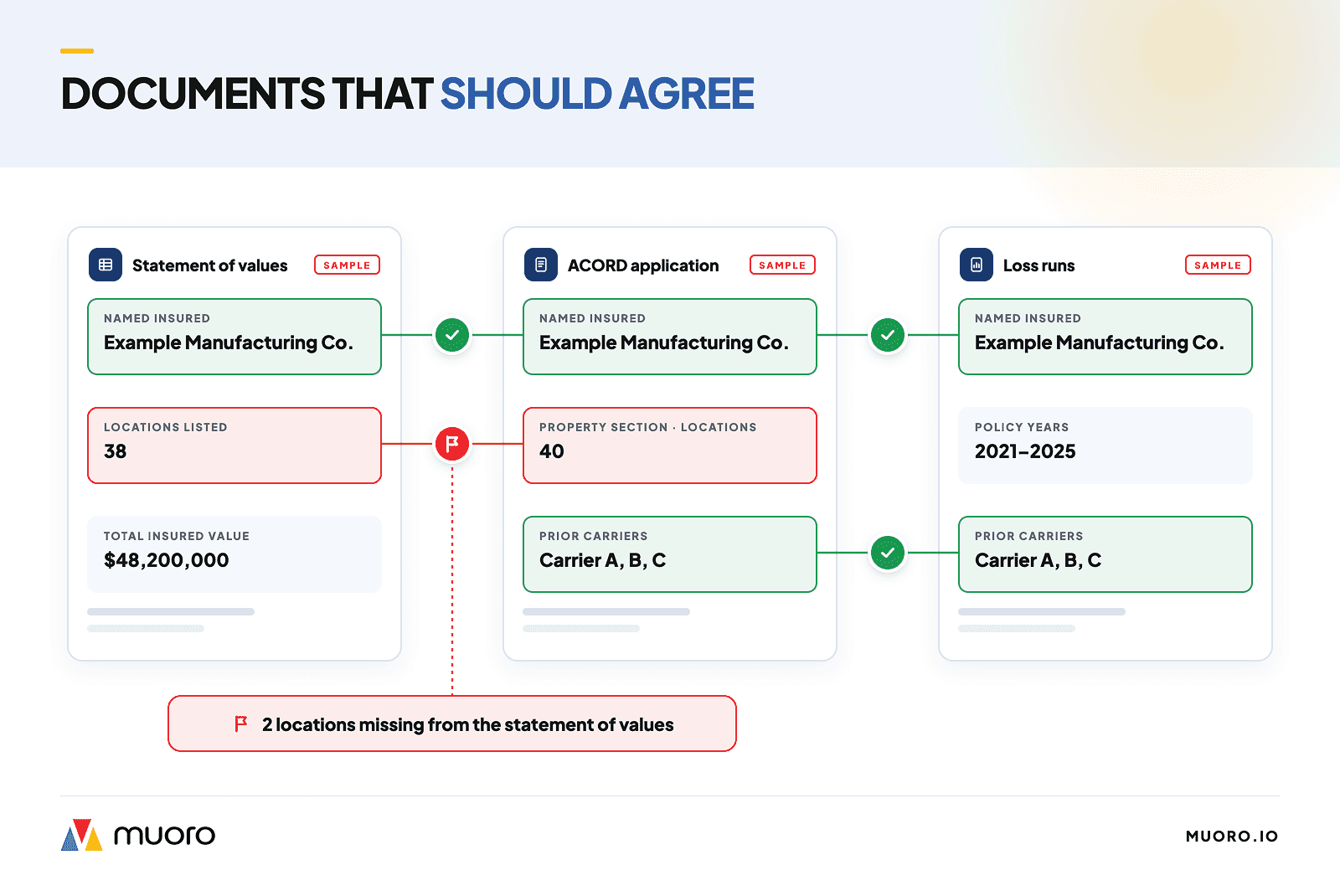
- The whole submission should agree: Named insureds, locations, prior carriers, exposures, and loss history are compared across documents to catch gaps and conflicts.
- Triage ranks, underwriters decide: Clearance and appetite rules sort submissions, but the decision to quote, the terms, and the price stay with the underwriter.
- Start with one line of business: Pick a high-volume line, test on your messiest submissions, and measure accuracy before adding the next line or channel.
A broker emails a submission for a mid-sized manufacturer. Attached are an ACORD application, five years of loss runs from three different carriers, a statement of values (SOV) spreadsheet with 40 locations, and a supplemental questionnaire. Before an underwriter can decide whether the account is worth quoting, someone has to open every file, find the details that matter, and key them into the underwriting system.
Most commercial business arrives this way, since about 85% of US property and casualty premiums are distributed through agents, brokers, and managing general agents, according to McKinsey, and the volume keeps growing. AM Best reports that the US surplus lines market reached a record $143.3 billion in direct premiums written in 2025. Yet in Accenture's 2025 survey of 430 underwriting executives across life and property and casualty insurance, only 9% said they use intelligent ingestion to extract and prepare data from submissions, although 68% expect to within three years.
This guide explains what makes insurance submission intake hard to automate, how AI handles ACORD forms and loss runs, and the checks that keep the extracted data accurate enough for an underwriter to rely on. It's written for commercial carriers, MGAs, and wholesale brokers, and it builds on the insurance section of our guide to intelligent document processing in financial services.
What Arrives in a Commercial Insurance Submission
A commercial submission is usually a package of documents, each holding different information in a different format.
Document | What it contains | What makes it hard to extract |
|---|---|---|
The broker's email | Context on the account, the effective date, target premium, deadlines, and the attachments | Key details are written in free text, and the email may be one of several in a thread |
ACORD application | The ACORD 125 commercial insurance application, plus line-specific sections such as the 126 for general liability, 140 for property, and 130 for workers' compensation | Different form versions, scanned or flattened PDFs, handwriting, and checkboxes that carry meaning |
Loss runs | Claim history from each prior carrier, usually covering several policy years | Every carrier uses its own layout and terms, and tables often run across many pages |
Statement of values | A list of locations, buildings, construction, occupancy, and insured values, usually in a spreadsheet | Columns, headings, and units change from broker to broker, with merged cells and hidden tabs |
Supplemental applications | Line-specific questionnaires, for example on cyber controls or fleet details | Many are carrier-specific forms with no standard layout |
Prior policies and other documents | Declarations pages, financial statements, inspection reports, and loss control reports | Long documents where only a few details matter |
An underwriter needs facts from almost all of these to judge the risk, and the facts have to agree with each other. Much of the work in submission intake, and many of its errors, come from that need for agreement.
Why Submission Intake Is Hard to Automate
Submission intake is still largely manual at many insurers, mostly because of the documents involved. In Accenture's survey, only 15% of underwriting organizations had automated the data entry and gathering needed to prepare submissions or renewals, and ineffective systems were the most common underwriting challenge, named by 65% of executives.
Submissions still arrive as documents
Only 8% of the executives Accenture surveyed receive submissions through broker APIs and portals today. The rest arrive by email, often with several attachments combined into one PDF, or spread across a thread as the broker sends missing pieces. Before anything can be extracted, the system has to split the files and work out what each one is.
ACORD forms vary in version and quality
ACORD forms give the industry a shared structure, but the copies that reach an underwriter vary. Brokers use different versions of the same form, some fill them in by hand, and many forms arrive as scans or flattened PDFs that have lost their form fields. Checkboxes, such as whether a location has a sprinkler system, are easy to misread and often matter to the decision.
Loss runs have no common format
Each carrier produces loss runs in its own layout, with its own names for the same fields. One calls a figure "total incurred" and another "net incurred," one lists each claim on a row and another groups claims by policy year, and many run to dozens of pages.
Statements of values change with every broker
A statement of values is usually a spreadsheet, but there's no fixed set of columns. Construction type might be a code in one broker's file and a description in another's, values might be in dollars or thousands, and some files hide extra locations on a second tab.
Information is missing or contradictory
Submissions often arrive incomplete, and the same risk can come in from more than one broker. Spotting what's missing, and which submission is a duplicate, is part of intake too.
How AI Submission Intake Works
AI submission intake turns a broker's email and attachments into a complete, checked file, so the underwriter starts with the decision rather than the data entry.
AI submission intake · 7 steps, with a loop back to the broker
Ingest, split, and classify
The system reads each incoming email, pulls out the attachments, and splits combined PDFs into separate documents. It then classifies each one as an ACORD application, a loss run, a statement of values, a supplemental, or something else. In Accenture's survey, only 10% of underwriting organizations use intelligent email to pre-sort broker requests today, but 75% expect to within three years.
Extract and map to one schema
Each document type needs its own extraction approach. ACORD forms need field and checkbox extraction, loss runs need table extraction, and statements of values need spreadsheet parsing. Everything is then mapped to one schema so a location, a policy year, or a claim means the same thing whichever document it came from. ACORD's own data standards are a sensible basis for that schema. In ACORD's 2026 Insurance Digital Maturity Study of 210 of the world's largest insurers, the most digitally mature carriers used ACORD data standards across the enterprise, and ACORD's research lead called data standardization a key prerequisite to using AI effectively.
Validate, triage, and hand over
The extracted data is checked against business rules, against the other documents in the submission, and against outside data. Gaps and conflicts either go back to the broker or are flagged for the underwriter. The submission is then cleared, matched against appetite, and prioritized, and the underwriter receives a complete file with every open question marked. The next three sections look at ACORD forms, loss runs, and cross-document checks in more detail.
Extracting ACORD Forms
ACORD forms are the most structured part of a submission, which makes ACORD form extraction a good place to start, although different versions, scans, and handwriting make them less consistent than they look.
The fields that matter most
For most commercial lines, the ACORD 125 and its line-specific sections hold the details an underwriter checks first. These include the named insured and any additional named insureds, the FEIN, the business description and NAICS code, mailing and location addresses, requested lines and limits, the proposed effective date, prior carriers and premiums, and the answers to the general information questions. Line sections add their own details, such as building construction and protection on the ACORD 140 or payroll by class code on the ACORD 130.
Versions, scans, and checkboxes
An extraction model has to recognize which version of a form it's reading, because fields move between editions. Scanned and flattened forms lose their underlying form fields, so the system has to read the page as an image. Checkboxes need special care, because a faint tick, a crossed-out box, or a handwritten "N/A" next to a question can change its meaning, and these answers often decide whether a risk fits appetite.
Rule checks for ACORD fields
Many of these errors can be caught with simple rules. A FEIN should have nine digits, a NAICS code should exist and match the business description, the effective date should fall in a sensible window, and every address should resolve to a real location. Limits and dates should also match across the 125 and its line sections. When a check fails, the field is flagged for review rather than passed on.
Mapping to ACORD data standards
Once the fields are extracted, mapping them to ACORD's data standards rather than a format invented for one system makes them easier to share with rating, clearance, and policy systems. ACORD has also built AI models of its own for turning nonstandard documents into standard data. In one reported example, reinsurer SCOR used them on broker claim advices and saw a 60% reduction in manual effort and an 80% improvement in data quality, according to ACORD. That was claims work rather than submissions, but the same principle of extracting into a shared standard applies.
Extracting Loss Runs
Loss runs are often the hardest part of a submission to automate, and one of the parts underwriters care about most. They show how the account has actually performed, and a misread figure can change the price or the decision to quote.
Normalize every carrier to one set of fields
The first job of loss run extraction is to turn each carrier's report into the same set of fields, whatever the original layout. A useful core set is the carrier, policy number, policy period, line of business, valuation date, claim number, date of loss, claim status (open or closed), paid amount, reserve, total incurred, and a short description of the loss. Terms differ between carriers, so the system needs a mapping for each one, for example treating "outstanding" and "reserve" as the same field.
Loss runs also tend to be long, with tables that continue over many pages and carry their headers forward inconsistently. The techniques in our guide to extracting tables from financial statements apply directly, especially stitching tables across pages and keeping every figure tied to its policy year.
Check the figures before anyone relies on them
Loss runs come with built-in arithmetic, which makes them easier to validate than many documents.
Check | What it catches |
|---|---|
Incurred equals paid plus reserve, for each claim | Misread figures and values in the wrong column |
Claim-level totals match the carrier's own summary for each policy year | Missed or duplicated claims, often from page breaks |
Claim counts match the summary | Dropped rows |
Every requested policy year is present, with no gaps between carriers | Missing years that the broker needs to supply |
The valuation date is recent | Loss runs too old to reflect current claims |
Dates of loss fall inside the policy period they're listed under | Claims assigned to the wrong year |
Any loss run that fails a check goes to a reviewer with the failing check highlighted. A missing year or a stale valuation date is usually a question for the broker rather than an extraction error, so the system should say which it is.
Summarize for the underwriter
Once the data is clean, the system can produce the view underwriters build by hand today, such as losses by policy year, frequency and severity trends, large losses above a threshold, and open claims with high reserves. The underwriter still reads the loss descriptions and judges what they mean for the account.
Checking the Submission as a Whole
Many intake tools check each document on its own. The more useful errors to catch are the ones where documents disagree with each other, because those are either extraction mistakes or real questions about the risk.
Compare | Across | What a mismatch might mean |
|---|---|---|
Named insured and FEIN | ACORD application, loss runs, prior policies | A subsidiary missing from the application, or loss runs for the wrong entity |
Locations | ACORD property section, statement of values | Locations left off one document, or values that don't match |
Policy periods and prior carriers | ACORD prior carrier section, loss runs | Missing loss runs, or a carrier the broker didn't mention |
Payroll, revenue, or vehicle counts | ACORD sections, supplementals, financials | Exposure figures that changed between documents |
Loss history | Loss runs, the ACORD loss history section, the broker's email | Losses disclosed in one place but not another |
We saw the value of this kind of check in our own projects, although neither was in insurance. In a lending project, the most important signal came from reconciling bank statements with marketplace sales data rather than reading either one alone, and in a KYC project, the biggest problems in early design testing came from messy documents rather than the model. Submission intake works the same way, because the ACORD forms, loss runs, and statement of values all describe one account and should agree.
Cross-document checks also help with document fraud. An edited loss run or an altered value on a statement of values is much harder to spot on its own than when it disagrees with the rest of the submission. Our post on document fraud detection covers the wider set of checks.
Triage, Clearance, and the Underwriter's Decision
Once a submission is extracted and checked, the system can help decide what happens to it next. Some submissions deserve far more attention than others. McKinsey has noted that a significant portion of brokers' submissions for quote requests fail to generate new business, so time spent keying in risks that will never be written is time taken from the ones that will.
Clearance and duplicates
Clearance checks whether the account is already being worked, either as an existing policy or as a submission from another broker. Matching on the named insured, FEIN, and addresses catches many duplicates, but names vary, so fuzzy matching and a person to confirm close calls both help.
Appetite and priority
Appetite rules check the class of business, location, limits, and loss history against what the carrier or MGA wants to write. Submissions that clearly fall outside appetite can be declined quickly and politely, so the broker gets an answer and can place the risk elsewhere. Those inside appetite can be ranked, for example by expected premium, fit, broker relationship, and how close the effective date is.
The underwriter makes the call
Triage should only decide what an underwriter looks at first. The decision to quote, the terms, and the price stay with the underwriter, who can see why the system ranked a submission the way it did.
Regulators expect this kind of oversight as well. The NAIC's model bulletin on insurers' use of AI asks insurers to keep a written AI program covering governance, risk management, and oversight of AI systems bought from third parties, and 29 jurisdictions had adopted it as of early November 2026. That oversight covers a lot of ground, because in NAIC surveys, 88% of auto insurers and 70% of homeowners insurers said they use, plan to use, or plan to explore AI or machine learning, with underwriting among the uses they reported. Our guide to AI governance in financial services [Internal link AI governance pillar] and our post on human-in-the-loop AI cover what that oversight looks like in practice.
How to Measure Submission Intake
Speed is the obvious measure, but on its own it can hide problems. A system that triages every submission in minutes isn't helping if underwriters have to recheck half the fields. These measures, tracked together, give a fuller picture.
Measure | What it tells you |
|---|---|
Time from receipt to triage | How quickly brokers get a first response |
Share of submissions triaged the same day | Whether the queue is under control |
Field-level accuracy on ACORD forms and loss runs | Whether extraction can be trusted, measured against a sample checked by people |
Share of submissions needing no manual correction | How much rework is left for underwriters and assistants |
Share of loss runs passing every validation check | How often the arithmetic and completeness checks catch problems |
Quote rate and hit rate on high-priority submissions | Whether triage is pointing underwriters at the right business |
Measure accuracy on your own submissions rather than relying on a vendor's figure, and check a sample of the submissions that went through without correction, since that's where missed errors hide.
Where to Start With Submission Intake Automation
Start with one line of business and one intake mailbox rather than every submission at once. Pick a line where volume is high and the documents are reasonably consistent, such as a small commercial package or workers' compensation, and leave complex specialty lines for later.
Build a test set from real submissions, including the messiest ones, such as scanned ACORD forms, loss runs from carriers you see rarely, and statements of values with unusual layouts. Measure field-level accuracy and the share of loss runs that pass every check before you scale. Then decide which failures go back to the broker, which go to an underwriting assistant, and which an underwriter needs to see.
Once the first line is working and underwriters trust what they're given, add the next line or channel.
How Much Are Your Underwriters Still Keying In?
Muoro tests extraction on your submissions, including complex loss runs, and provides an accuracy baseline and a 90-day IDP roadmap.
Frequently Asked Questions
What is submission intake in insurance?
Submission intake is everything that happens between a broker sending a request for a quote and an underwriter starting to assess the risk. It includes receiving the email, sorting the documents, extracting the details into the underwriting system, checking for duplicates and appetite, and routing the submission to the right underwriter.
What is a loss run report?
A loss run report is a carrier's record of the claims made under a policy, usually covering several policy years. It lists each claim with its date, status, amount paid, reserve, and total incurred. Underwriters use loss runs from prior carriers to judge how an account has performed before they quote it.
Can AI read ACORD forms accurately?
Usually, especially when the forms are digital. Scanned forms, handwriting, and checkboxes are harder, so accuracy should be measured on your own submissions. Simple rule checks, such as a nine-digit FEIN and valid NAICS codes, catch many of the remaining errors before they reach an underwriter.
How do you handle loss runs from different carriers?
Map every carrier's layout and terms to one set of fields, such as policy period, valuation date, paid, reserve, and incurred. Then check that incurred equals paid plus reserve, that totals match the carrier's summary, and that no policy years are missing. Loss runs that fail a check go to a reviewer.
What is a statement of values, and can AI extract it?
A statement of values lists the locations and buildings to be insured, with details such as construction, occupancy, and insured values. It's usually a spreadsheet, so extraction is more about mapping inconsistent columns and units than reading text. AI can help, as long as the results are checked against the property section of the ACORD application.
Does AI decide which submissions to quote?
No. AI can extract the data, check it, and rank submissions so underwriters see the best-fitting ones first, but the decision to quote, the terms, and the price should stay with the underwriter. The NAIC's model bulletin on insurers' use of AI also expects insurers to keep oversight of how AI is used.
How do MGAs and wholesale brokers use submission intake automation?
Many MGAs and wholesalers handle high volumes of submissions with small teams, which makes intake automation especially useful. AM Best reports that MGAs and other delegated authority enterprises wrote $108.7 billion in direct premiums in 2025, up 17.8% from 2024. The same steps apply, with the added need to apply each carrier partner's appetite and authority limits.
What do regulators expect when insurers use AI in underwriting?
In states that have adopted the NAIC's model bulletin, insurers are expected to keep a written AI program that covers governance, risk management, testing, and oversight of third-party AI systems. In practice, that means documenting how intake and triage models work, testing their accuracy, and keeping a person responsible for underwriting decisions.
Start your project with Muoro!
Fill out the form and our business team will reach out to you within 24 hours.
Similar Blog Posts
Similar Blog Posts


Start Building Data-First Production AI
Move beyond pilots. Build AI systems that drive real decisions and measurable outcomes.
TALK TO US