

How Financial Firms Detect Fake Bank Data
How lenders, insurers, and wealth firms detect fake bank statements, pay stubs, and AI-generated documents, and why one-document checks fall short. (

Generative AI has made fake bank statements, pay stubs, claim documents, and IDs much harder to spot by eye. Inscribe saw the monthly volume of AI-generated documents it flagged grow fourfold in a year. This guide explains which document fraud checks still work, where they belong in an intelligent document processing (IDP) pipeline, and how lenders, insurers, and onboarding teams can apply them.
- AI-altered documents are hardest to catch: A real statement or pay stub with one edited figure keeps its genuine layout, fonts, and transactions, so it can pass a visual check.
- Single-document red flags fall short: Font, alignment, and typo checks still catch templates, but a good fake usually fails only when compared with the rest of the file.
- Six layers of detection: File metadata, layout analysis, arithmetic checks, cross-document reconciliation, outside data, and pattern analysis each catch what the others miss.
- Cross-document checks do most of the work: Net pay is matched to payroll deposits, stated income to tax transcripts, and repair invoices to adjuster estimates.
- Outside data is the strongest evidence: Bank data pulled with consent, IRS transcripts, claim history databases, and issuer checks come from sources applicants don't control.
- Fraud checks belong early in the pipeline: Run them before extracted data feeds a decision, give every flag a readable reason, and route files by risk rather than document type.
- False positives need managing: Weigh signals together, tune checks by source, and let reviewers ask customers specific questions before a file is declined.
- Measure performance as a set: Track catch rate, false positives, straight-through rate, time to decision, and losses avoided, and sample files that went straight through.
Fake bank statement detection used to be a matter of spotting sloppy work. A forged statement had the wrong font, columns that drifted out of line, or a balance that didn't add up. Generative AI has changed that. Inscribe, which screens documents for lenders, saw the monthly volume of documents it flagged as AI-generated grow fourfold between June 2025 and May 2026.
Lenders aren't the only ones seeing it. In Verisk's 2026 study of 300 insurance claims professionals, 99% said they had come across manipulated or AI-altered documentation. Onboarding teams, meanwhile, are dealing with AI-generated identity documents, which FinCEN warned financial institutions about in 2024.
This guide covers how document fraud has changed, which document fraud detection checks still work, and where those checks belong in an intelligent document processing (IDP) pipeline. It starts with lenders, because pay stubs and bank statements are the documents fraudsters target most, and then turns to insurers and onboarding teams. For a broader view of IDP, see the document fraud section of our guide to intelligent document processing in financial services.
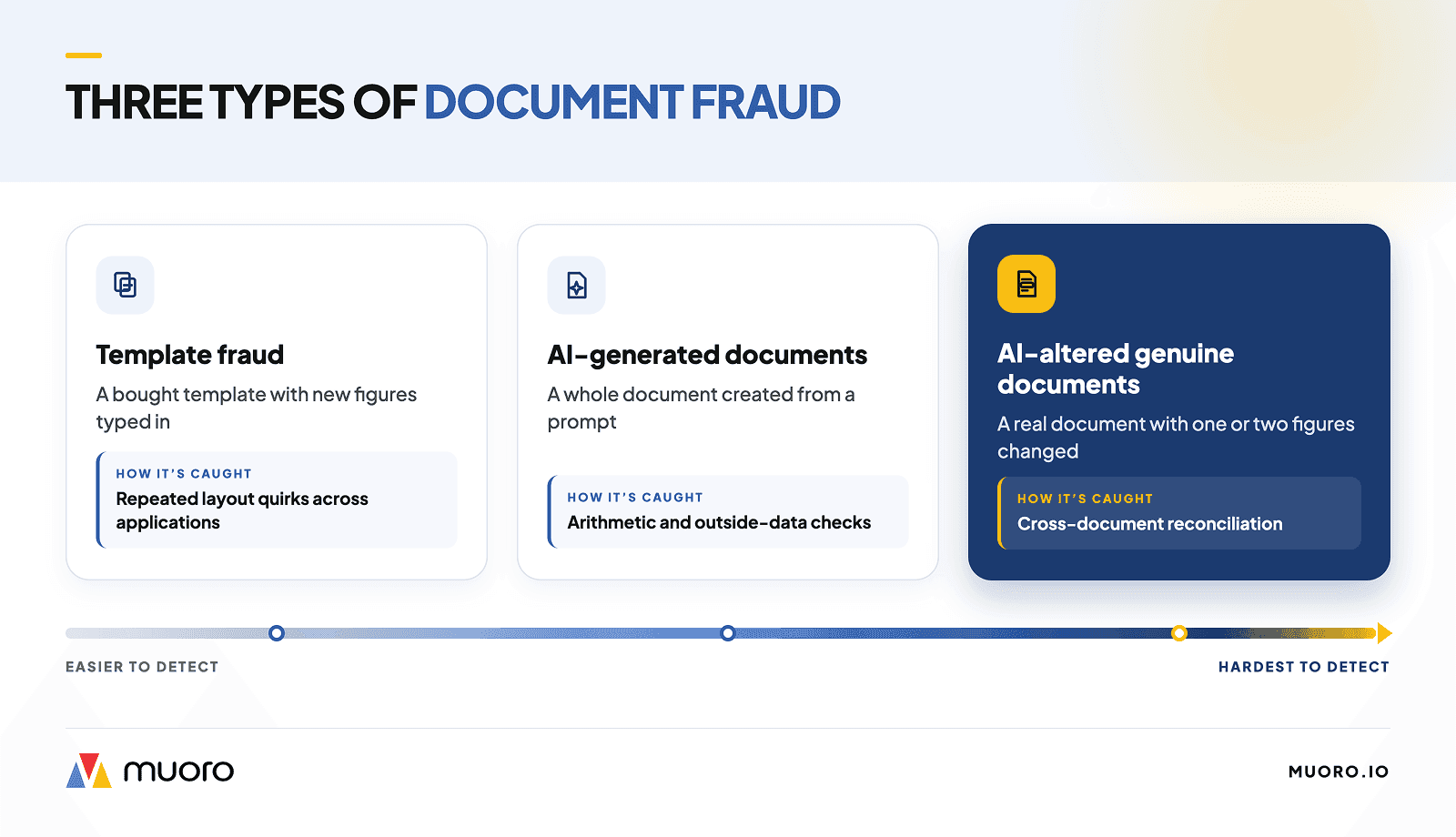
Three Types of Document Fraud and Why AI-Altered Documents Are Hardest to Detect
Fake documents are made in different ways, and the method decides which checks will catch them.
Template fraud
The most familiar kind starts with a template of a bank statement or pay stub, often bought online, with the fraudster's own figures typed in. It remains more common than fully AI-generated fakes, and Inscribe sees two to three times more template fraud than AI-generated fraud across its network. Templates also tend to give themselves away over time, because the same layout quirks appear in applications from different people.
AI-generated documents
In this case, a whole statement, invoice, or pay stub is created from a prompt. Early versions were easy to spot. Inscribe describes perfectly aligned tables, transaction amounts that were all round numbers, and generic payees such as "grocery store" where a real statement would show a named merchant and an amount like $47.13. Newer tools are learning to avoid those tells.
AI-altered genuine documents
The hardest case is a real document with a few targeted edits, such as a bank statement with a higher closing balance or a pay stub with inflated income. Everything apart from the edited figure is genuine, including the layout, the logo, the fonts, and most of the transactions. In a September 2026 interview, a mortgage fraud specialist speaking in a Cotality interview said AI has made a single altered PDF "virtually undetectable" on its own. If one document can't be trusted by itself, detection has to look at the evidence around it.
Which Financial Documents Are Most Often Faked or Edited
Fraudsters edit the documents that decide whether money moves. For lenders, that means anything that proves income or cash. For insurers, it means proof of a loss and what it cost, and for onboarding teams it means proof of identity.
Firm type | Documents most often faked or edited | What usually changes |
|---|---|---|
Lenders | Bank statements, pay stubs, tax returns, and, for small business loans, invoices | Income, balances, deposits, and employer details |
Insurers | Claim photos, repair estimates, invoices, and receipts | The extent of the damage and the amounts claimed |
Wealth firms and onboarding teams | Driver's licenses, passports, and proof of address | Names, photos, dates of birth, and addresses |
Why Single-Document Checks No Longer Catch Fake Bank Statements
Most guides to spotting a fake bank statement offer the same list of red flags, such as mismatched fonts, misaligned columns, typos, totals that don't add up, and figures that end in too many zeros. The list still catches template fraud and careless edits, but a well-made AI fake gets those details right.
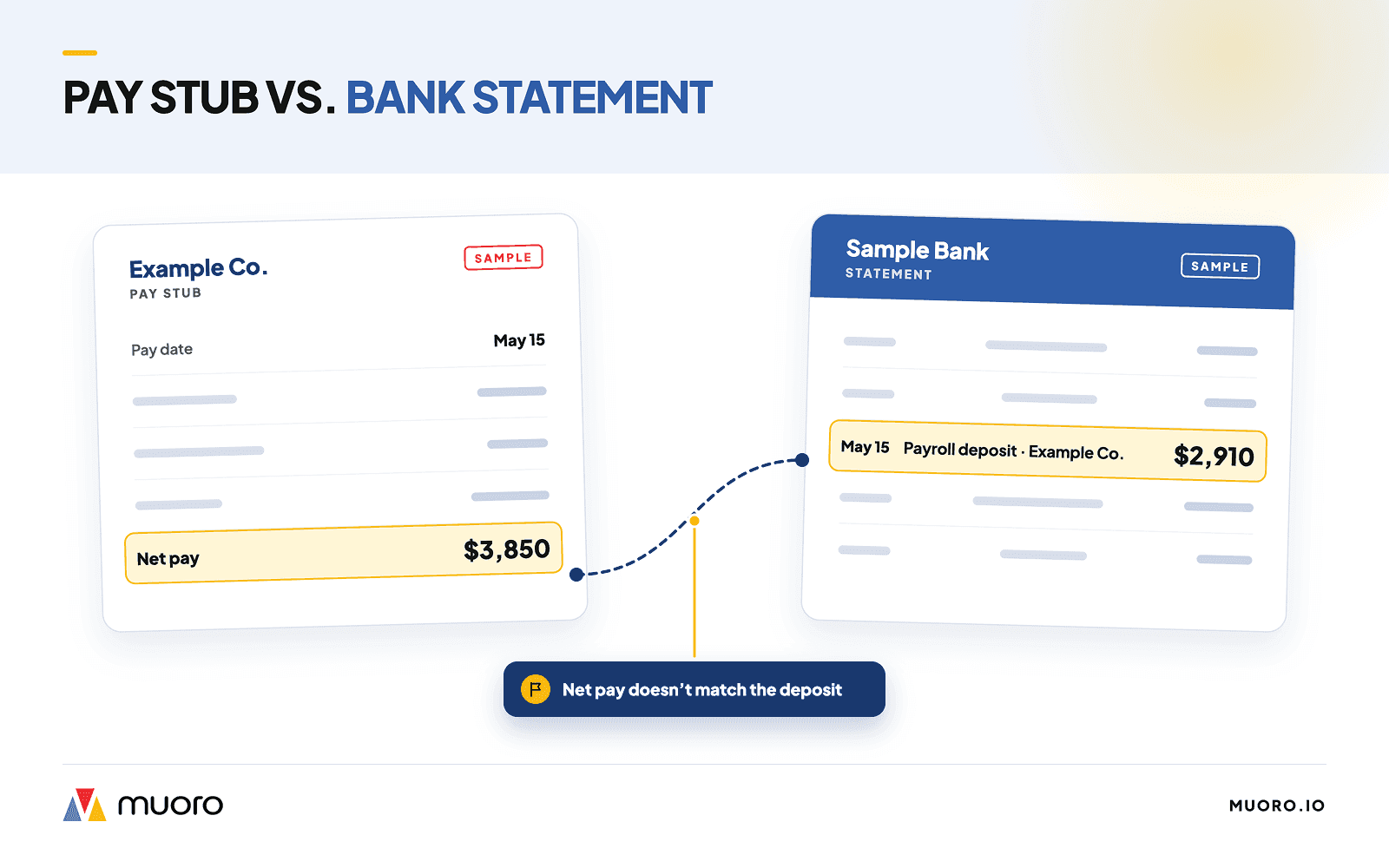
Where a fake usually fails is in agreeing with everything else in the file. An edited pay stub can show a higher salary, yet the payroll deposits on the applicant's bank statement still reflect the old one. An inflated repair invoice won't match the adjuster's estimate or the damage in the photos. A generated ID still has to line up with the address, phone number, and device on the rest of the application.
In practice, the most reliable evidence now comes from the file around a document rather than the document itself. We saw this in a project for a lender to e-commerce sellers, where the core of the underwriting pipeline was reconciling each seller's bank statements with their marketplace sales data. The gap between reported sales and the cash that actually reached the bank account was what mattered, and no single document showed it.
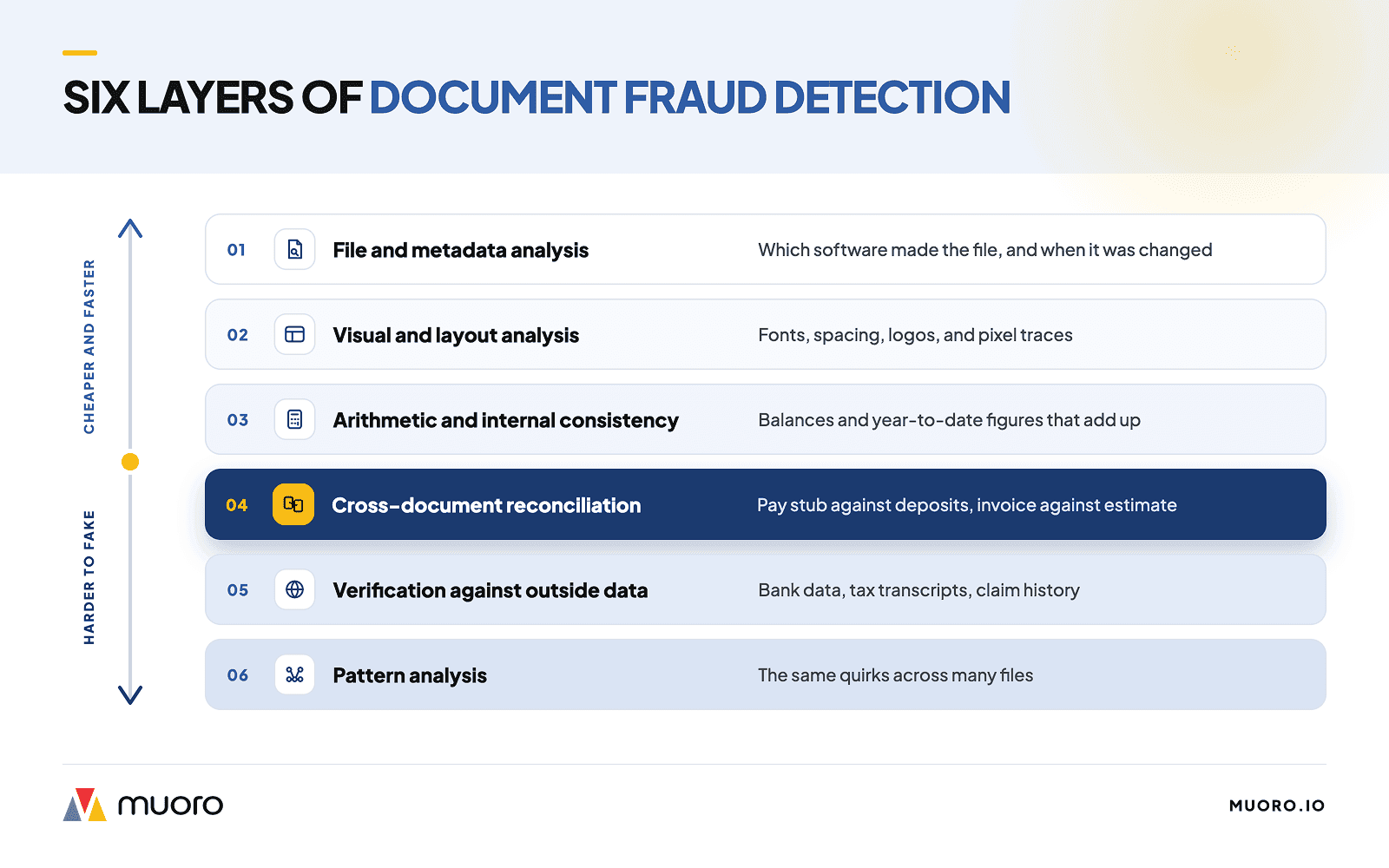
Six Layers of Document Fraud Detection
No single check is enough on its own. Each of the six layers below catches something the others miss, and the cheaper ones should run first.
File and metadata analysis
A PDF records more than what appears on the page. Its properties show which software created it and when, and many PDFs keep traces of earlier versions after they're edited and saved again. A bank statement created in a word processor, or modified two days before it was uploaded, deserves a closer look. These checks are fast and inexpensive, but they're also easy to defeat, since printing and scanning a document or rebuilding the file wipes its history.
Visual and layout analysis
Layout checks look for traces of editing on the page itself, such as one figure in a slightly different font or size, spacing that shifts partway down a column, a blurry logo on an otherwise sharp page, or pixel patterns that suggest part of an image was replaced. Detection models trained on large numbers of genuine statements from the same issuer can catch edits a reviewer's eye would miss, though this is also the layer AI-generated fakes are learning to beat fastest.
Arithmetic and internal consistency checks
A genuine document agrees with itself. On a bank statement, the opening balance plus deposits minus withdrawals should equal the closing balance on every page. On a pay stub, year-to-date figures should fit the pay rate and the number of pay periods so far, and tax withholding should be plausible for that income. Ocrolus, which analyzes small business lending applications, reports that unreconciled bank statement balances, where the transactions don't add up to the balance shown, roughly doubled year over year to nearly 20,000 incidents a month in early 2026. These checks only work if extraction gets the tables right, including tables that run across several pages [Internal link: Mon 23 Nov post on extracting tables from financial statements; add once live].
Cross-document reconciliation
A good fake usually fails at this layer, where each document's claims are compared with the rest of the file. Net pay on the pay stub is checked against payroll deposits on the bank statement, stated income against the tax return, and the employer on the pay stub against the deposit descriptions. In insurance, the repair invoice is checked against the adjuster's estimate, and in onboarding, the name and address on an ID are checked against the application. Each comparison is simple, and the value comes from running all of them on every file rather than relying on an underwriter to notice.
Verification against outside data
The strongest evidence comes from sources the applicant doesn't control. Lenders can use consumer-permissioned bank data connections instead of uploaded statements, along with employment and income verification services and IRS tax transcripts requested with the applicant's consent on Form 4506-C. Insurers can check claims against industry claim history databases, and onboarding teams can verify identity documents against issuer data where it's available. Once the original source is in hand, the uploaded copy matters much less.
Pattern analysis across applications and claims
Some fraud only becomes visible in aggregate, for example the same template quirks across applications from different people, the same field edited in the same way, or a cluster of applications with similar incomes coming from one broker. The mortgage fraud specialist in the Cotality interview recommends this portfolio-level view because single documents are getting harder to judge. In insurance, the same approach applies to repair shops, medical providers, or addresses that appear in an unusual number of claims.
Where Document Fraud Detection Fits in an IDP Pipeline
Most IDP pipelines classify a document, extract its data, and validate the extracted fields against business rules. Fraud checks belong inside that flow rather than in a separate tool someone has to remember to run.
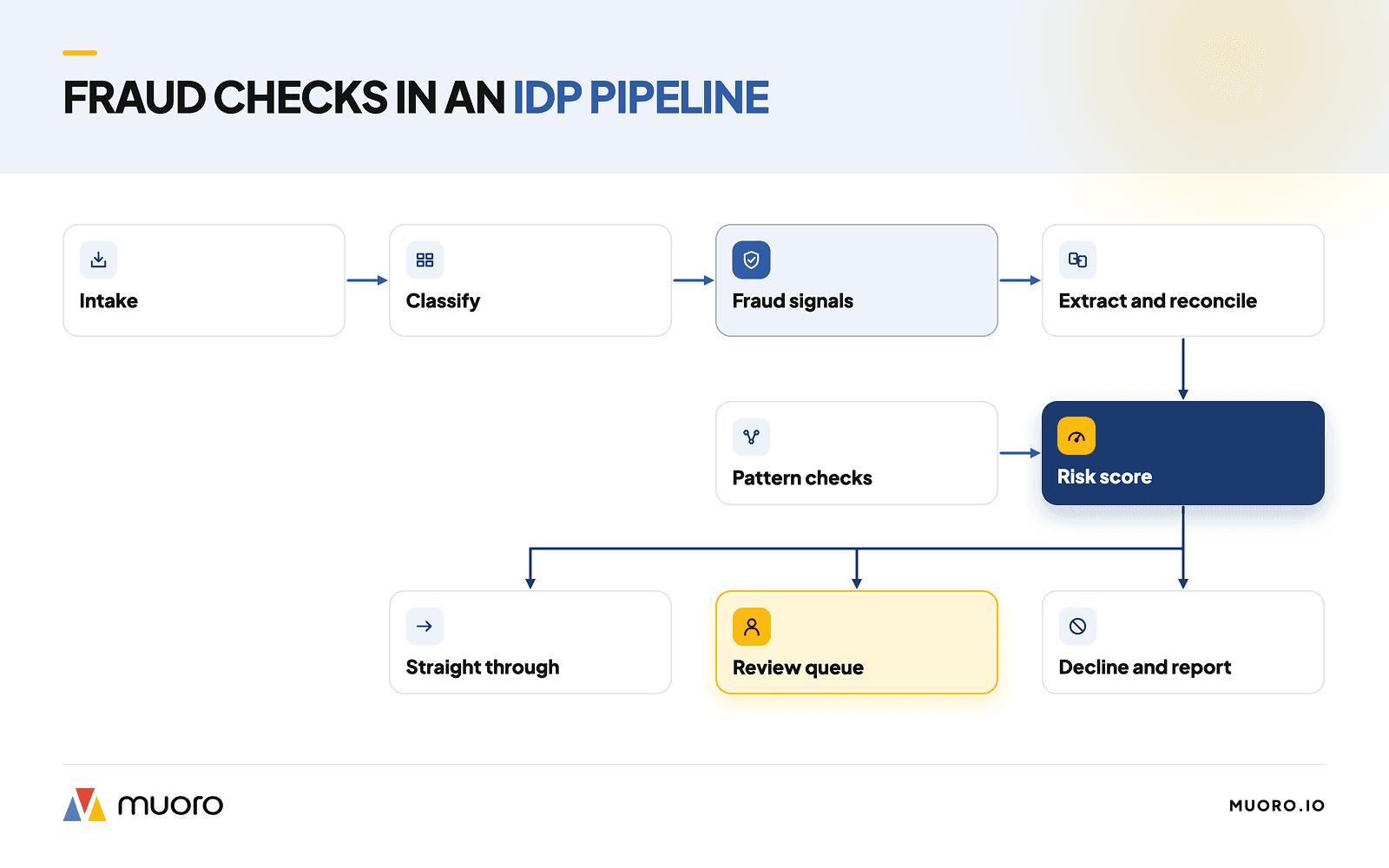
Document fraud checks in an IDP pipeline · 6 steps, 3 outcomes
Three design choices make the biggest difference.
Fraud signals should run before anyone relies on the data. File, layout, and arithmetic checks can start as soon as a document is classified, because there's no point extracting the balance from an edited statement and feeding it into a credit model.
Every flag also needs a reason a person can read. A reviewer can't act on "risk score 0.82," but "the closing balance doesn't match the transactions on page 3" or "the employer on the pay stub doesn't match the deposit description" tells them where to look and what to ask the customer.
Finally, files should be routed by risk rather than by document type. Most files can go straight through. Those with open flags go to a review queue, and only confirmed fraud is declined and, where required, reported, which keeps reviewers focused on the files that need them.
Document Fraud Detection for Lenders, Insurers, and Onboarding Teams
The six layers apply across financial services, but lenders, insurers, and onboarding teams each have their own weak points.
Fake bank statement and pay stub detection for lenders
In a loan file, the figures fraudsters edit are usually income and cash. Inscribe found that 91.2% of the altered documents it flagged in 2025 had edited financial figures. When fraud gets through, the cost goes well beyond the loan itself, and LexisNexis Risk Solutions puts the true cost to US lenders of every $1 of fraud at $4.84 once fees, recovery, and operations are included.
Cross-document reconciliation does most of the work in a loan file, and a few lending-specific checks sit on top of it. Stated income should be supported by IRS transcripts requested through Form 4506-C. For small business loans, revenue on invoices or marketplace reports should show up as cash in the business account, and transfers between the owner's own accounts shouldn't be counted as income.
Where possible, pull bank data directly with the applicant's permission rather than accepting an uploaded statement. A document the applicant never handled is much harder to fake.
Detecting AI-altered insurance claim photos and documents
Insurers face a version of the problem that lenders mostly don't, because many edits can come from ordinary policyholders rather than organized fraud rings. In Verisk's study, 36% of 1,000 US consumers said they would consider digitally altering a claim image or document, and the figure rose to 55% among Gen Z. More than half of the claims professionals surveyed believe at least half of the policyholders who alter claim media don't realize it may count as fraud.
The edits are also getting harder to spot. According to Claims Journal's coverage of the study, 76% of claims professionals said manipulated submissions had become more sophisticated in the past year, and only 32% felt very confident identifying deepfakes. Tools aren't solving the problem by themselves either, since 39% cited poor integration between fraud tools and claims systems and 38% said their tools miss too many altered images and documents.
For claims teams, the most useful step is controlling how photos are captured. Photos taken through the insurer's own app, which records when and where they were taken, are much harder to manipulate than images uploaded from a camera roll. Beyond that, the repair invoice should match the estimate, both should match the damage in the photos, and the claimant should be checked against industry claim history databases. Repair shops or providers that appear in an unusual number of claims deserve a closer look too.
Intelligent document processing in insurance runs into similar document problems earlier in the cycle, at submission intake, where carriers read ACORD forms and loss runs from many different sources [Internal link: Wed 25 Nov post on commercial insurance submission intake; add once live].
Identity document verification for wealth firms and onboarding teams
At account opening, the document most likely to be faked is the ID itself. In a November 2024 alert, FinCEN warned that criminals have used generative AI to alter or create images of driver's licenses and passports and then combined them with stolen or fake personal information to build synthetic identities.
Most of the red flags FinCEN lists come down to consistency. A customer's photo may show signs of editing or not match their other identifying information, several identity documents from the same person may disagree with each other, or the customer's location and device data may not fit their documents. FinCEN also lists a photo or video being flagged by commercial or open-source deepfake detection software.
FinCEN asks institutions that file suspicious activity reports (SARs) on these schemes to include the key term "FIN-2024-DEEPFAKEFRAUD" so the reports can be grouped and analyzed. A clear record of which checks flagged a document, and why, makes that filing much easier. Our guide to AI governance in financial services covers the wider evidence trail regulators expect.
Reducing False Positives in Document Fraud Detection
A fraud check that flags too much creates its own problems. Genuine customers wait longer, reviewers stop trusting the flags, and real fakes get lost in the queue. In Verisk's study, 35% of claims professionals reported false positives as a problem with their current tools.
The biggest improvement comes from weighing signals together. A PDF made in a word processor isn't evidence of fraud by itself, since plenty of small employers produce pay stubs that way, but it matters when it comes with a deposit that doesn't match. Tuning checks by source helps too. Statements from a bank you've processed thousands of times can be held to a stricter standard than a layout you've never seen, where unfamiliarity alone shouldn't count against the applicant.
Many flags have innocent explanations, such as a mid-year raise, a second job, or a statement downloaded in an unusual format. A reviewer who can see the exact reason for a flag can ask the customer a specific question instead of rejecting the file. The system can decide which files go straight through, but a person should decide which are declined or reported. Our post on human-in-the-loop AI covers which decisions need human approval.
Reviewer decisions are useful data in their own right. Recording whether each flag turned out to be fraud, an honest mistake, or a false alarm is how the checks improve over time.
Measuring the Performance of a Document Fraud Detection Program
Fraud checks are hard to evaluate, because missed fraud doesn't announce itself. Five measures, tracked together, give a fair picture.
Measure | What it tells you | Data source |
|---|---|---|
Catch rate | The share of known fraud the checks flagged | Flags compared with confirmed fraud, including cases found later through early defaults or claim investigations |
False positive rate | The share of flagged files that turned out to be genuine | Reviewer outcomes on every flag |
Straight-through rate | The share of files that needed no review | Pipeline logs |
Time to decision | How long flagged and unflagged files take | Pipeline and case management timestamps |
Losses avoided | The value of fraud stopped before money moved | Confirmed fraud cases, valued at the amount applied for or claimed |
All of these measures depend on extraction accuracy.
Where to Start With Document Fraud Detection
Pick the workflow where a fake document costs you most, such as income verification for lenders or claim invoices for insurers, and start there rather than trying to cover every document at once. Run the metadata, arithmetic, and cross-document checks on a sample of recent files, including some you already know were fraudulent, to see what the checks catch and how many genuine files they flag. Then set up the review queue and the reason behind each flag before you scale.
Make your document workflows ready for AI
Identify accuracy gaps, improve fraud checks, and get a 90-day plan for your first production IDP workflow.
Frequently Asked Questions About Document Fraud Detection
How can you tell if a bank statement has been edited with AI?
Often you can't from the statement alone. Start with the file's metadata and the arithmetic, checking that every running balance follows from the one before it. Then compare the statement with the rest of the file, including pay stub deposits, tax data, and the application, or pull the account data directly from the bank with the customer's permission.
Can AI edit a bank statement well enough to fool a lender?
Yes, if the lender only looks at the document. A genuine statement with one balance changed keeps its real layout, fonts, and transactions. What it usually can't do is agree with the applicant's other documents and outside data, which is why reconciliation catches what a visual check misses.
Can AI detect fake documents?
AI detection models can spot many edits and AI-generated documents, especially when they're trained on large numbers of genuine documents from the same issuer. They aren't reliable enough to use alone, though. In Verisk's 2026 study, 38% of claims professionals said their tools miss too many altered images and documents, so detection works best alongside cross-document and outside-data checks.
What is the difference between template fraud and AI-generated documents?
Template fraud uses a ready-made layout, often bought online, with the fraudster's own figures typed in. AI-generated documents are created from a prompt. Templates repeat the same quirks across many applications, so pattern analysis catches them well, while AI-generated documents vary more and need arithmetic, reconciliation, and outside-data checks.
What should a lender do when a pay stub looks fake?
The first step is to verify rather than reject. Check whether the net pay matches deposits on the bank statement, confirm income through an independent source such as an employment verification service or IRS transcripts, and ask the applicant a specific question about the mismatch. If fraud is confirmed, follow your institution's procedures, including any reporting obligations.
How do insurers detect AI-altered claim photos and invoices?
The most effective step is controlling how photos are captured, through an app that records the time and location of each one. Insurers then compare the photos, estimate, and invoice with each other and check the claimant's history in industry databases.
Do financial institutions have to report AI document fraud?
Institutions with suspicious activity reporting obligations, such as banks, have to file a SAR when activity meets the reporting rules for their type of institution, whether or not AI was involved. For schemes involving deepfake media, FinCEN asks filers to include the key term "FIN-2024-DEEPFAKEFRAUD." Your compliance team can confirm which obligations apply to your firm.
How do you stop fraud checks from slowing down genuine customers?
Run the checks automatically, let low-risk files go straight through, and give reviewers a specific reason for every flag so they can resolve it quickly. Pulling data directly from banks and payroll providers also reduces the number of uploaded documents that need close scrutiny.
Does document fraud detection replace fraud analysts?
No. It takes over repetitive work such as arithmetic checks, metadata checks, and matching documents against each other, so analysts can spend their time on files that need judgment. A person should still make the final decision on any file that's declined or reported.
Start your project with Muoro!
Fill out the form and our business team will reach out to you within 24 hours.
Similar Blog Posts
Similar Blog Posts


Start Building Data-First Production AI
Move beyond pilots. Build AI systems that drive real decisions and measurable outcomes.
TALK TO US