

What Are Benefits of SSR Node.js Solutions?
Optimized websites with SSR Node.js solutions can achieve faster load times, improved SEO, and better performance with server-side rendering for dynamic web pages.

Slow websites cost businesses traffic, customers, and revenue. JavaScript-heavy sites often struggle with SEO. Search engines fail to index dynamic content, making it harder for users to find your business. High bounce rates and poor rankings follow.
SSR Nodejs solutions fix this. Server-side rendering (SSR) pre-renders content before it reaches users, speeding up load times, improving search rankings, and enhancing user experience. A fast, SEO-friendly site means better engagement and higher conversions.
Web performance is critical for business owners, CTOs, developers, and marketers. Whether you run an e-commerce site, SaaS platform, or content-based business, SSR with Node.js gives you a competitive edge. This guide will show you how to implement it and solve key business challenges.
The SEO and Performance Challenges of Client-Side Rendering
Modern businesses rely on fast, high-ranking websites to drive traffic and sales. But Client-Side Rendering (CSR) can create serious SEO and performance issues, leading to lost revenue and poor user experience.
How CSR Works
CSR loads content dynamically in the browser. The page appears blank until JavaScript executes, delaying rendering. This slows down load times, affecting both users and SEO rankings.
Build and run governed AI systems
We turn your data into measurable outcomes you can track and act on.
SEO Issues with CSR
- Search engines struggle to index JavaScript-heavy sites, reducing visibility.
- Slow speeds hurt Core Web Vitals like Largest Contentful Paint (LCP) and First Input Delay (FID), lowering rankings.
- Social media previews break because meta tags aren’t preloaded, leading to poor engagement.
Business Impact
- Lower organic traffic due to poor indexing.
- High bounce rates as users leave slow-loading pages.
- Lost conversions when potential customers abandon the site.
The solution? SSR Nodejs solutions. So, by pre-rendering pages on the server, SSR delivers content instantly, improving speed, SEO, and engagement. Businesses using SSR with Nodejs solutions see higher rankings, lower bounce rates, and better conversions. If slow load times and weak SEO are hurting your business, it’s time to adopt SSR Nodejs solutions for a faster, search-friendly web experience.
💡 Pro tip: Google’s ranking system prioritizes fast-loading and well-structured content. CSR alone might hurt your visibility.
What is Server-Side Rendering in Node.js?
Businesses need fast, SEO-friendly websites to stay competitive. Slow load times and poor search visibility cost traffic and conversions. SSR Nodejs solutions fix this by delivering pre-rendered content quickly, which improves both user experience and SEO.
SSR vs. CSR: What’s the Difference?
SSR (Server-Side Rendering) – The server pre-renders content before sending it to users. This speeds up load times and makes pages easier for search engines to index.
CSR (Client-Side Rendering) – The browser renders content after downloading JavaScript. This can delay page load times and hurt SEO.
Why Choose Node.js for SSR?
Faster execution – Handles high traffic efficiently, ensuring seamless performance.
SEO-friendly – Delivers fully rendered HTML for search engines, boosting rankings.
Compatible with top frameworks – Works with React, Angular, Vue, and Express.js.
How It Works
1. The server fetches data, renders the page, and sends fully loaded HTML to the browser.
2. Users see a complete page instantly, reducing bounce rates and improving engagement.
3. Search engines easily crawl and index content, enhancing search visibility.
With SSR Nodejs solutions, businesses solve speed and SEO issues, driving more traffic and conversions. If slow load times and poor rankings are holding you back, it’s time to implement SSR Nodejs solutions for a faster, optimized web experience.
💡 Pro tip: Google prioritizes pages that load fast and offer meaningful content upfront. SSR aligns perfectly with these ranking factors.
Key SEO Benefits of Using SSR with Node.js
Slow websites lose traffic, rankings, and revenue. Search engines struggle with JavaScript-heavy pages, leading to poor indexing and visibility. Businesses need a solution that improves both speed and SEO. SSR Nodejs solutions solve this by pre-rendering content, making pages load faster and rank higher.
Faster Page Load Speeds
Speed matters. Slow websites frustrate users, increasing bounce rates. SSR Nodejs solutions pre-render pages on the server, reducing load times and improving user engagement. Faster pages mean better retention and higher conversions.
Improved Core Web Vitals
Google ranks sites based on core web vitals, such as the largest contentful paint. The best part? SSR reduces the time it takes for content to appear, thus boosting LCP scores and search rankings.
Better Search Engine Indexing
Google bots struggle to index JavaScript-rendered pages. SSR sends fully rendered HTML, making it easy for search engines to crawl and rank content. This leads to higher organic traffic.
Optimized Social Media Previews
Broken link previews hurt engagement. With SSR Nodejs solutions, metadata is pre-rendered, ensuring correct titles, descriptions, and images are displayed when shared. This boosts social traffic and click-through rates.
Improved Accessibility & UX
Users expect instant content. SSR delivers fully loaded pages immediately, benefiting all users, including those on slow networks or assistive devices. The result? A better user experience means higher retention and more conversions.
Real-World Examples of SSR Nodejs Solutions
Many businesses have successfully improved their SEO and traffic by switching from Client-Side Rendering (CSR) to SSR. Here are some notable cases:
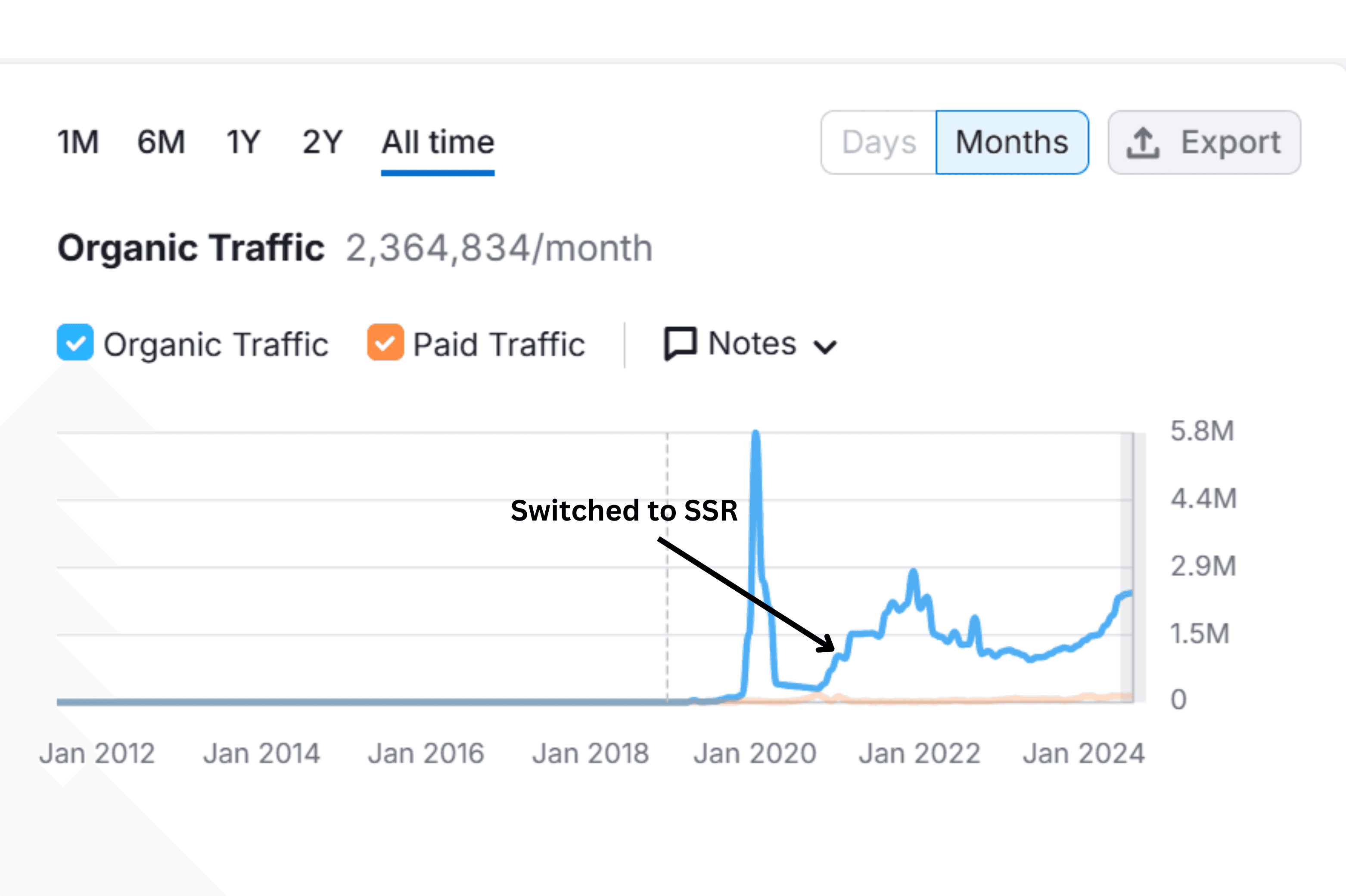
Invideo: +35% Organic Traffic Growth
Before mid-2021, Invideo.io saw one traffic peak in 2020, but it suddenly dropped as they relied on CSR (as seen in the Semrush graph). After migrating to SSR, the platform saw a drastic increase in organic traffic. The switch improved indexing, leading to better search rankings and visibility.
eXp Realty: From Zero to 200K Non-Branded Searches
In 2022, eXpRealty.com transitioned to SSR, shifting away from CSR-based rendering. As a result, the site went from zero non-branded searches to 200K per month. The result? The change allowed search engines to crawl and rank key pages effectively, unlocking a massive SEO boost.
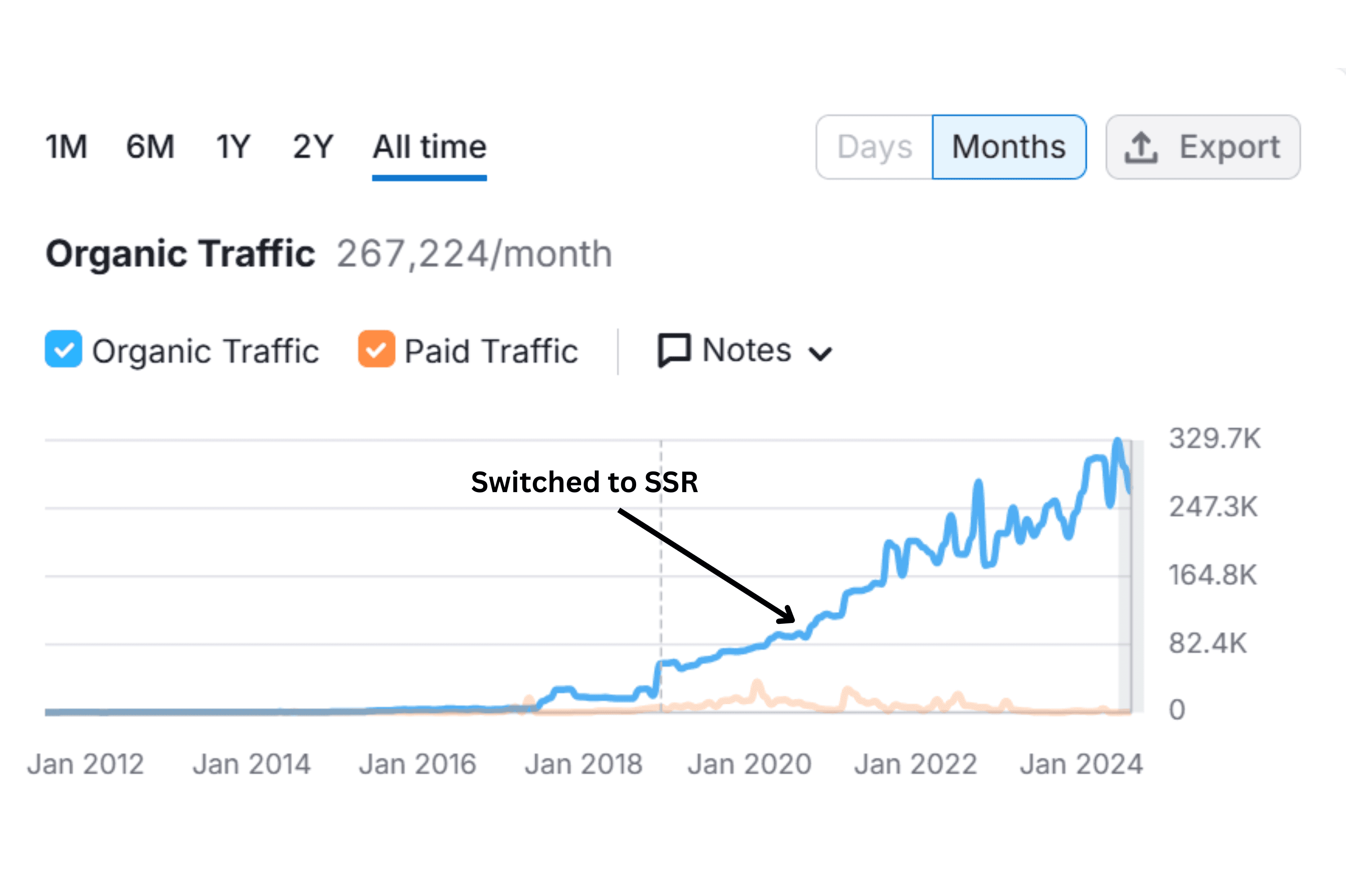
Semrush data.
Silkfred: 2x Increase in Organic Traffic
Silkfred faced SEO challenges due to CSR-based pagination. The brand experienced a 2x increase in organic traffic and a rise in keyword rankings after migrating to SSR. What's more? This SEO transformation came at the 2020 Brighton SEO conference and was later documented in an in-depth case study.
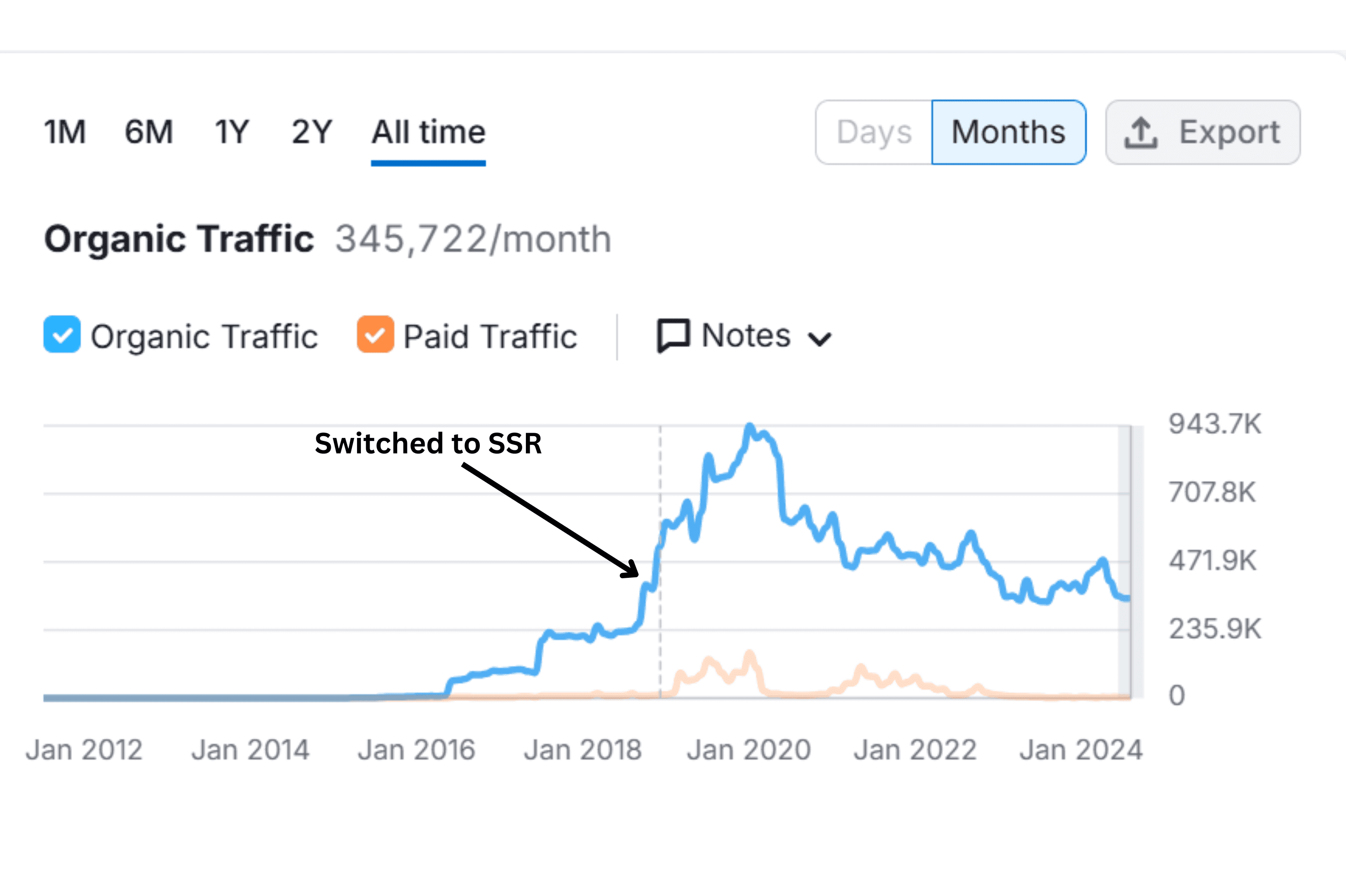
Semrush data.
Airtable: 40-50% Traffic Uplift
In 2021, Airtable switched from CSR to SSR, improving page load times and search engine indexing. According to an analysis by Rachel Church, this transition resulted in a 40-50% increase in organic traffic.
If slow pages and weak SEO are hurting your business, it's time to adopt SSR Nodejs solutions. Speed, visibility, and conversions depend on it.
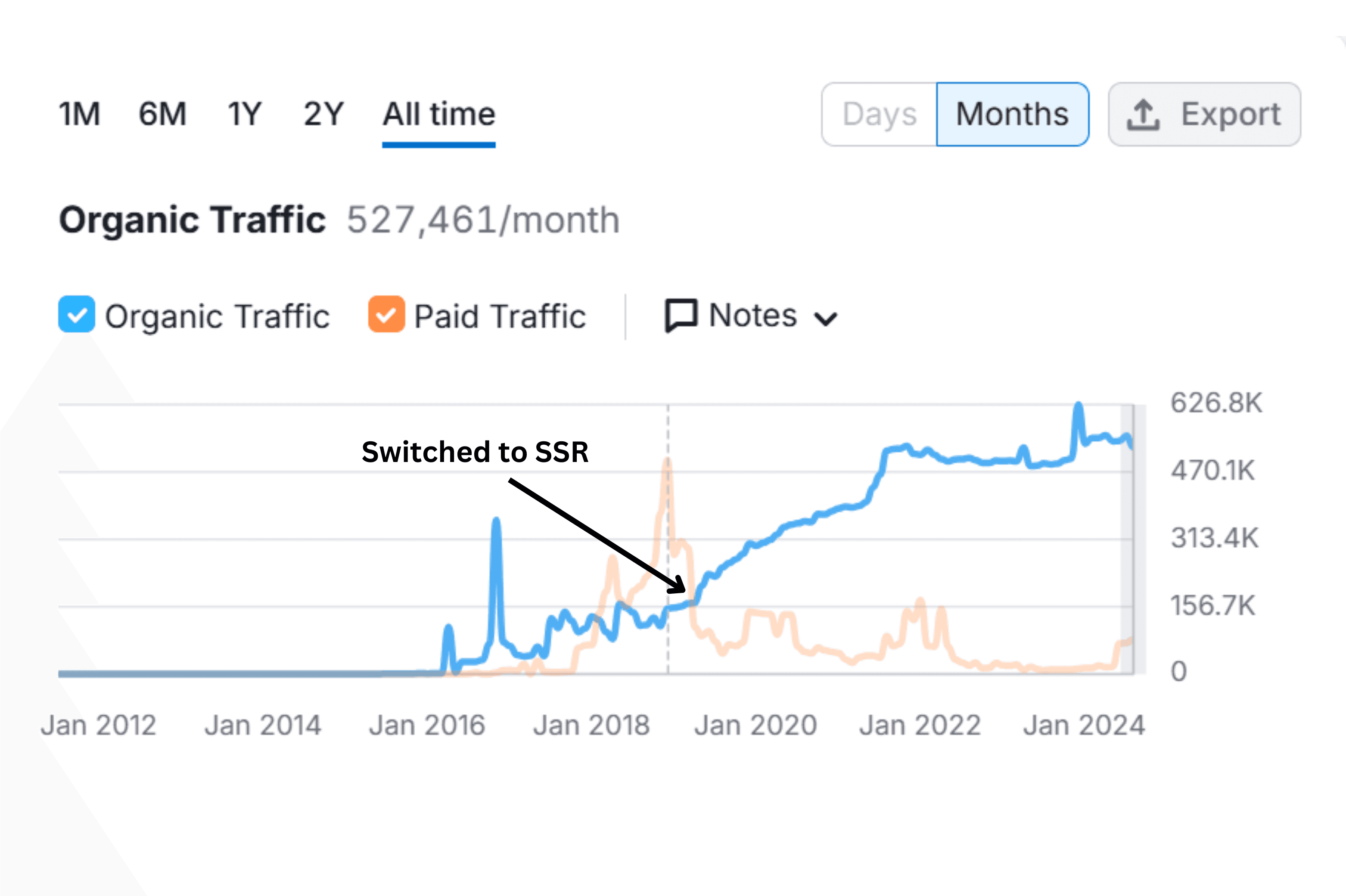
Semrush data.
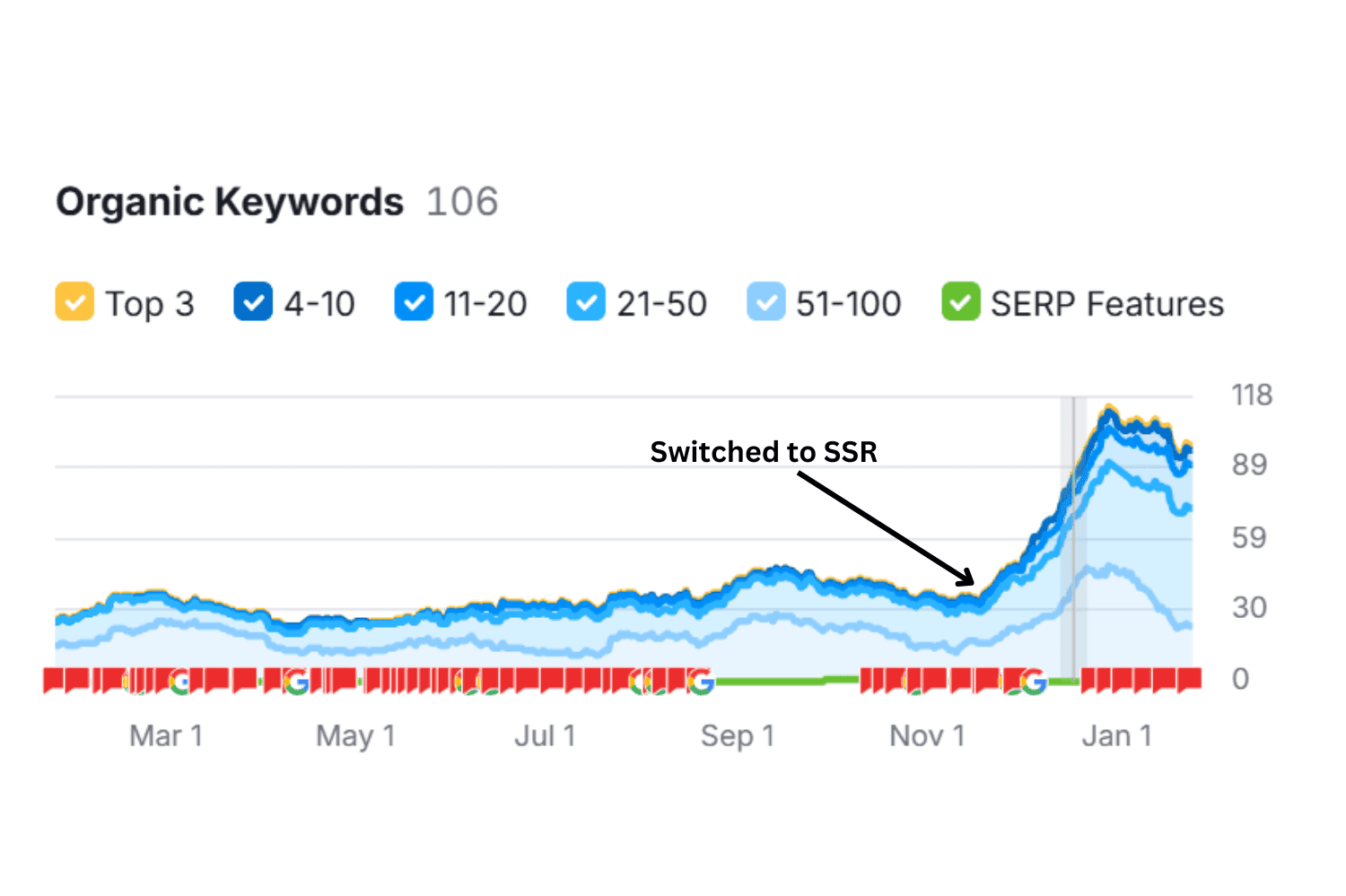
Muoro: 400%+ Traffic Uplift In A Month
At Muoro, we switched to SSR and saw a traffic boost within just two months. Our marketing experts, Raj Trivedi and Siddhesh Patankar, predict that traffic and rankings will surpass 1,000% by Q2 this year. Our current website runs on a headless CMS, and by combining it with SSR, we can index pages faster—often within 10 minutes of publishing.
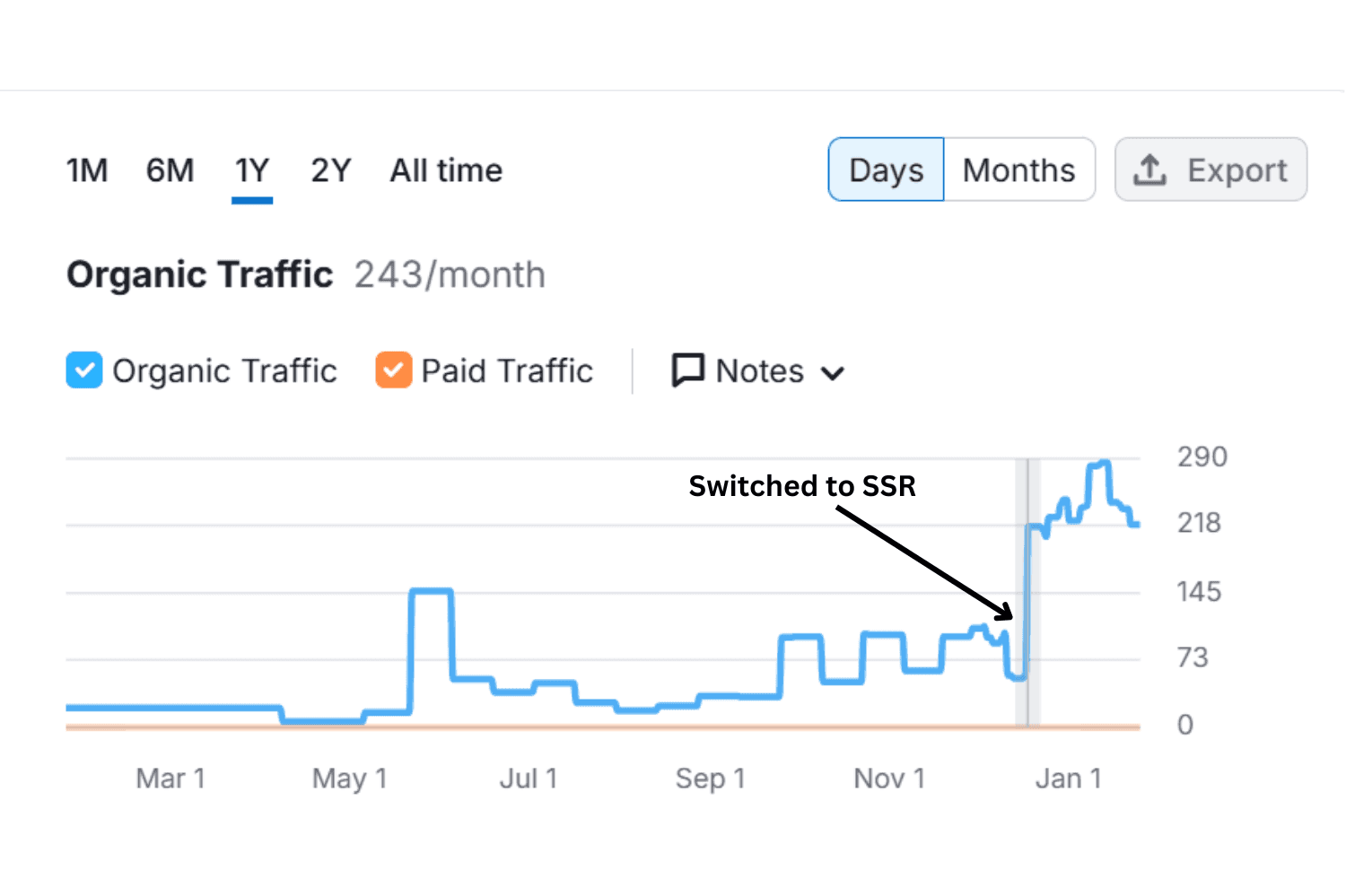
Semrush data traffic.
This showcases the power of SSR in driving SEO success.
💡 Pro tip: Fast-loading pages improve engagement and conversions. Google rewards sites that deliver value quickly.
Implementing SSR with Node.js: Step-by-Step Guide
Slow websites cost businesses traffic, rankings, and revenue. SSR Nodejs solutions solve this by delivering fast, SEO-friendly pages. Follow these steps to implement SSR with Node.js.
Step 1: Set Up a Basic Node.js Server
Create an Express.js server to handle SSR requests.
Javascript:
const express = require("express");
const app = express();
app.get("/", (req, res) => {
res.send("<h1>Server-Side Rendered Page</h1>");
});
app.listen(3000, () => console.log("Server running on port 3000"));
Why? → Ensures users and search engines receive fully rendered content instantly.
Step 2: Integrate SSR with React (Example with Next.js)
Pre-render React pages on the server to improve SEO and speed.
Javascript:
import { GetServerSideProps } from "next";
export default function Page({ data }) {
return <h1>{data.title}</h1>;
}
export const getServerSideProps: GetServerSideProps = async () => {
const res = await fetch("https://api.example.com/data");
const data = await res.json();
return { props: { data } };
};
Why? → SSR Nodejs solutions make content instantly available to users and search engines.
Step 3: Optimize Metadata for SEO
Ensure search engines and social media display the correct page information.
Javascript:
import Head from "next/head";
export default function Home() {
return (
<Head>
<title>SSR with Node.js</title>
<meta name="description" content="Boost SEO and performance with Server-Side Rendering in Node.js." />
</Head>
);
}
Why? → Without this, pages may not display correctly in search results or previews.
Step 4: Deploying an SSR App
Host and optimize your SSR app for performance and scalability.
Recommended Hosting → Use Vercel, AWS, DigitalOcean, or Firebase Hosting for reliable deployment.
Use a CDN → Cache static content to improve load speed and reduce server requests.
Why Do Your Businesses Need SSR Nodejs Solutions?
A slow site leads to high bounce rates and lost revenue. SSR Nodejs solutions help businesses deliver faster pages, improve SEO, and gain a competitive edge. If your site struggles with speed and rankings, it’s time to switch to SSR.
💡 Pro tip: Implementing SSR the right way ensures better visibility and a seamless user experience.
Common Mistakes and How to Fix Them
Many companies implement SSR but miss key optimizations, leading to performance issues. SSR Node.js solutions fix these problems by improving speed, search visibility, and user experience. Here are common mistakes and how to solve them.
Not Caching SSR Responses
Problem: Every user request triggers full-page rendering, slowing down performance.
Solution: Use Redis or CDN caching to store rendered pages. This reduces server load and speeds up response times. SSR Node.js solutions with caching ensure a smooth and scalable experience.
Too Many API Calls on Every Request
Problem: Making multiple API calls for each page request increases load time.
Solution: Batch API requests and cache responses. This minimizes redundant calls and speeds up data retrieval. Efficient SSR Node.js solutions optimize API usage for better performance.
Ignoring Mobile Optimization
Problem: A website that isn’t mobile-friendly leads to higher bounce rates and lower rankings.
Solution: Test with Google Lighthouse to analyze mobile speed and usability. Optimizing for mobile ensures SSR Node.js solutions deliver fast, responsive experiences across all devices.
Skipping Schema Markup
Problem: Search engines struggle to understand page content, reducing search visibility.
Solution: Use JSON-LD schema markup to help Google index content correctly. Proper schema boosts rankings, making SSR Node.js solutions even more effective for SEO.
Mistakes in SSR setup can slow down websites, hurt SEO, and cost conversions. SSR Node.js solutions solve these problems by improving speed, scalability, and search performance. Fix these issues now and stay ahead.
💡 Pro tip: Google favors pages that are fast, mobile-friendly, and well-structured. Avoiding these mistakes will improve rankings.
Conclusion
Slow websites hurt rankings, traffic, and conversions. Businesses need a solution that improves speed and search visibility. SSR Nodejs solutions solve this by delivering pre-rendered content, making sites faster and more SEO-friendly.
With SSR, pages load instantly, improving user experience and reducing bounce rates. Search engines can crawl and index content more effectively, leading to higher rankings and increased organic traffic. It integrates seamlessly with modern frameworks like React, Vue, and Angular, making it a flexible and scalable solution.
For businesses, better performance means more engagement and higher conversions. If your site struggles with slow speeds or poor SEO, it’s time to act.
Want expert help in implementing SSR for your business? Talk to our team today and see how we can optimize your website for speed, visibility, and growth.
Start your project with Muoro!
Fill out the form and our business team will reach out to you within 24 hours.
No similar blogs found for this article.
Latest Blogs
Latest Blogs


Start Building Data-First Production AI
Move beyond pilots. Build AI systems that drive real decisions and measurable outcomes.
TALK TO US