

Product Lifecycle Management for GenAI Tools: What CTOs Forget
Product lifecycle management for software development of GenAI tools ensures structured planning, iterative delivery, compliance, and continuous model evolution.

GenAI tools aren’t static features; they behave like adaptive systems. Outputs vary with small changes in context, prompt structure, or the state of the underlying model.
Most teams still view GenAI as an add-on feature. They run isolated experiments, launch basic prototypes, and skip core engineering steps. The result? This approach leads to inconsistent user experiences, unpredictable costs, and systems that malfunction as usage scales.
That approach doesn’t work.
To build and maintain reliable AI-driven systems, you need structured product lifecycle management for software development for GenAI tools. The same principles that guide traditional product development, versioning, evaluation, and release planning must apply here, but with new considerations for model behavior, prompt variability, and third-party dependency.
This blog outlines what makes GenAI product development different. It walks through a GenAI-ready lifecycle, details technical components you need at each stage, and explains why centralized lifecycle oversight is critical at scale.
Whether you're leading LLM software development, architecting custom LLM development, or managing full LLM application development, your team needs a strategy that accounts for how these tools actually behave in production.
Done right, it becomes the foundation for scalable and reliable GenAI platforms.
What Makes GenAI Product Development Different
GenAI systems don’t behave like traditional software. Their outputs aren’t fixed. The same input can produce different results depending on prompt structure, context, or retrieval data. That makes GenAI tools harder to test, monitor, and control.
You also depend on external infrastructure, model APIs, vector databases, and embedding engines. Changes in those systems affect your product without warning. A silent model upgrade by OpenAI or a vector DB indexing issue can impact performance overnight.
Another concern: privacy. If your prompts include sensitive user data or confidential business inputs, misconfigured logging or prompt templates can expose information.
Standard software lifecycles aren’t enough.
You need a product approach built around variability. That includes prompt versioning, retrieval logic audits, model behavior tracking, and evaluation loops.
You’re not just building code; you’re managing cognition.
You’re releasing decision systems that interpret data in real time. Such an endeavor demands new practices across testing, monitoring, and updates.
Traditional tools can’t track hallucination rates or retrieval drift. You need a framework that supports product lifecycle management for software development for GenAI tools, where evaluation isn’t a phase but a continuous process.
If you're working on LLM in software development or planning full LLM app development, build around this reality. It’s the only way to ensure long-term performance and trust.
A GenAI-Ready Product Lifecycle Framework
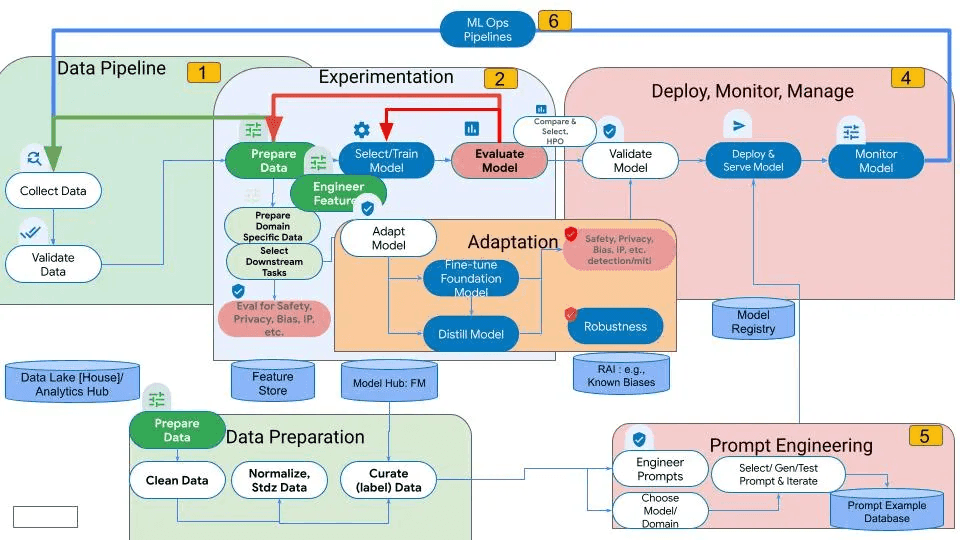
GenAI tools require a structured approach that goes far beyond traditional build-and-release cycles. Their behavior depends on external systems, user input, and evolving context. Without a tailored framework, projects often stall after the prototype stage or fail silently in production.
You need product lifecycle management for software development for GenAI tools that can handle prompt variability, model drift, and continuous feedback. This isn’t optional; it’s foundational to scaling GenAI features across your stack.
Source: Medium
Here’s a framework built for modern LLM software development:
Build and run governed AI systems
We turn your data into measurable outcomes you can track and act on.
Ideation
Identify the use case, define success criteria, and document expected output formats. Consider user prompts, data boundaries, and retrieval scope from the start.
PoC
Use basic model APIs to test feasibility. Keep it narrow. Focus on answering: Does the model generate useful responses at all?
Tuning
Introduce retrieval, chunking, and scoring layers. Apply prompt templates. Create internal evaluation sets and test variations.
Evaluation
Score hallucinations, latency, token cost, and retrieval accuracy. Capture failure modes. Refine prompts and data scope based on metrics.
Release
Launch with observability, version control for prompts, and retrieval logs. Monitor drift and latency. Don’t treat it as “done.”
Optimization
Incorporate real-world feedback, add logic for reranking or fallback, and improve retrieval coverage. Re-embed documents if the LLM infra changes.
This lifecycle reduces rework and improves time-to-market. It aligns your teams on a shared process that adapts as your GenAI products evolve.
Without disciplined product lifecycle management for software development for GenAI tools, most teams hit a wall after the prototype phase. They face scaling issues, unstable outputs, and mounting tech debt.
Understand each phase of the LLM development life cycle to implement a life cycle that supports sustainable GenAI growth.
Key Tech Stack Components Across the Lifecycle
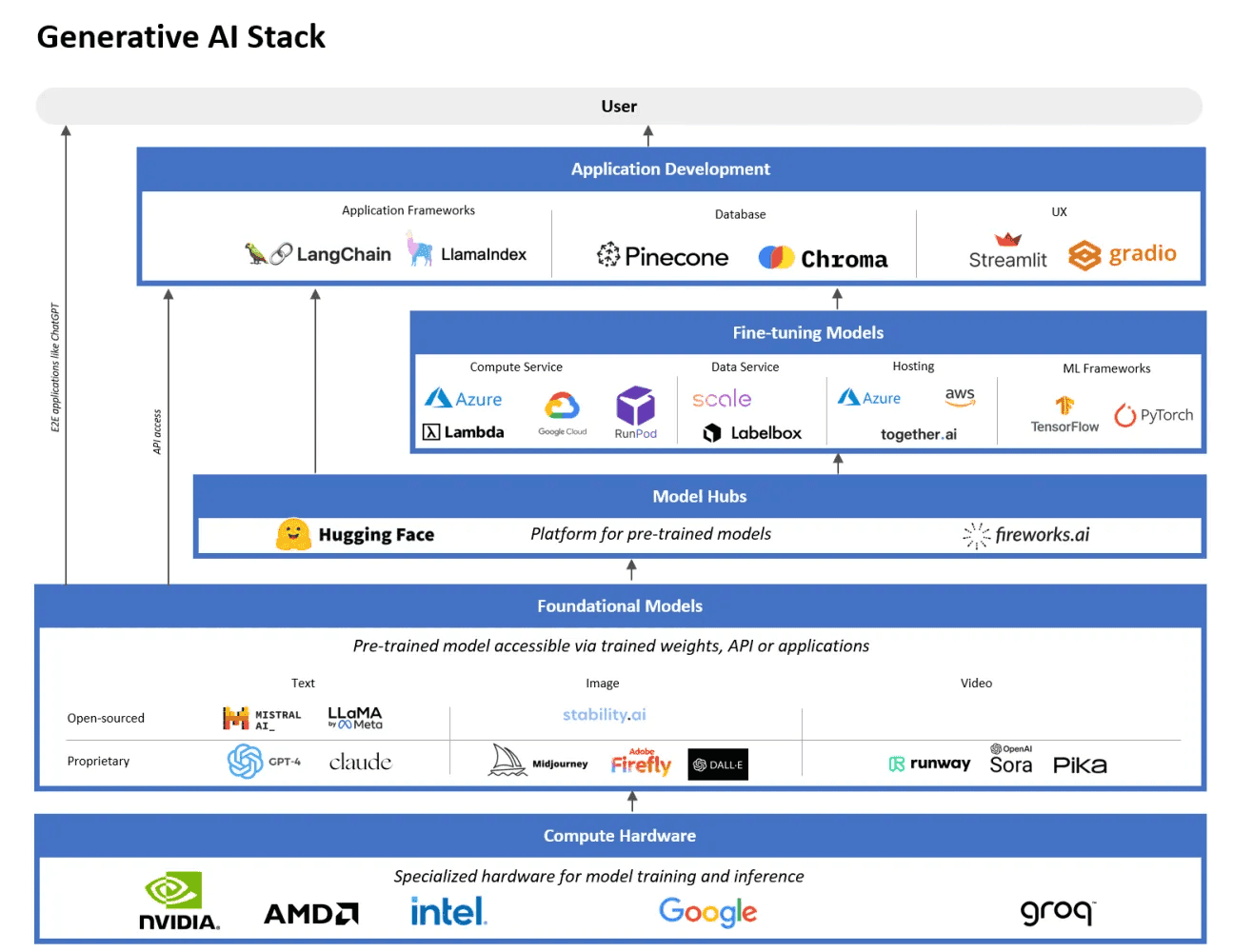
Building and scaling GenAI products requires a consistent, production-grade stack. Most teams start with quick wins, LangChain wrappers, basic vector databases, and prompt tuning in notebooks. But that approach breaks down as complexity increases.
Source: LinkedIn
Tooling is fragmented. You often end up stitching together APIs, custom scripts, and evaluation tools. To implement reliable product lifecycle management for software development for GenAI tools, you need a modular and scalable stack.
Here are the core components you’ll rely on:
Prompt libraries and version control
Manage variations, test responses across updates, and track which prompts perform best.
Vector search systems
Tools like Weaviate, Pinecone, or Qdrant support rapid retrieval. Performance varies with indexing, scaling, and filtering options.
Evaluation frameworks
Track hallucination rates, response consistency, and semantic drift over time. Use these signals to improve prompts and retrieval logic.
Retrieval logic, chunking, and scoring
Precision matters. The wrong chunking strategy reduces relevance. Poor scoring leads to semantic noise.
Model monitoring and analytics
Track token usage, response latency, and error rates. Add fallback logic if third-party models degrade.
What separates mature teams from hobby projects is infrastructure.
Invest in scalable LLM infra early. Avoid hardcoding behavior into brittle chains. Add CI pipelines, output regression tests, and observability.
As your use cases grow, shift from experimentation to full LLM software development with lifecycle controls, feedback loops, and team-wide standards.
This shift makes debugging faster, reduces cost overruns, and prepares your stack for real-world demands.
Explore how we build LLM platforms that scale
ModelOps and AI Lifecycle Best Practices
Shipping GenAI products without ModelOps is risky. These systems behave differently from typical models or rule-based apps. They require ongoing validation, versioning, and monitoring across the entire lifecycle.
A standard DevOps workflow won’t catch common failure points. It doesn't handle:
- Prompt version control—Minor prompt edits can change output quality.
- Model rollout tracking—LLM APIs evolve silently; updates may affect production outputs.
- Context injection accuracy—Retrieval pipelines must deliver the right data in the right format.
- Grounding and hallucination rates—You need to track when the LLM generates unsupported claims.
To manage this, adopt a ModelOps framework built for LLMs. That includes:
- Evaluation datasets with known outputs to catch regressions
- Tracking tools for latency, token usage, and semantic accuracy
- Automated tests for prompt chains and retrieval steps
- Human-in-the-loop review flows for edge cases and high-impact queries
These workflows should be part of your CI/CD pipeline, not manual steps after deployment.
Applying modelops framework AI model lifecycle management best practices to GenAI systems means going beyond training and fine-tuning. It involves continuous prompt evaluation, retrieval tuning, and feedback loops that improve over time.
A robust MLOps framework helps you detect model drift, broken chains, or changes in response tone that affect user trust. It enables you to ship updates faster while maintaining control.
When your GenAI products grow in scale, neglecting ModelOps becomes a liability. You need infrastructure that’s purpose-built for product lifecycle management for software development for GenAI tools, not borrowed from legacy AI workflows.
See how we build ModelOps pipelines for LLM products
Why Enterprises Need Centralized Lifecycle Management
As GenAI adoption grows across teams, many organizations face the same problem: every team builds its own pipeline, retriever, and evaluation loop.
Without centralized product lifecycle management for software development for GenAI tools, you create duplication, inefficiencies, and compliance risks.
The most common issues:
- Repeated prompt chain bugs across different apps
- Untracked model or embedding version changes
- Redundant API usage inflating inference and hosting costs
- Fragmented LLM development processes that are hard to monitor
A centralized lifecycle strategy solves this.
It allows you to:
- Audit model versions, prompt templates, and retrieval logic across teams
- Standardize how prompts are evaluated, scored, and released
- Control costs by consolidating infrastructure and shared APIs
- Enforce privacy and compliance through unified logging and access controls
This is more than governance; it’s platform thinking.
When LLM tools are treated as core services, you gain visibility, traceability, and shared infrastructure. You avoid maintaining multiple versions of the same LLM software development stack.
Enterprises building across legal, support, sales, and internal tools need this approach. Without it, your platform becomes brittle as use cases expand.
Centralized product lifecycle management for software development for GenAI tools lets you scale reliably across departments, tools, and use cases while keeping your system maintainable.
Final Thoughts
Your GenAI product won’t scale if it’s built like a prototype or wrapped around a single API call. These tools demand a real engineering approach, one that accounts for prompt drift, model changes, and evolving user inputs.
Structured product lifecycle management for software development for GenAI tools is essential. It gives your team repeatable evaluation gates, CI pipelines, and shared LLM infra that can support long-term growth.
Without it, costs spike, outputs degrade, and trust erodes. With it, you can ship faster, scale safely, and adapt as the model ecosystem shifts.
If you're building custom LLMs, integrating vector pipelines, or planning full LLM app development, treat the lifecycle as a product priority, not an afterthought.
Start your project with Muoro!
Fill out the form and our business team will reach out to you within 24 hours.
Similar Blog Posts
Similar Blog Posts


Start Building Data-First Production AI
Move beyond pilots. Build AI systems that drive real decisions and measurable outcomes.
TALK TO US