

Google Agentic Data Cloud vs Databricks vs Snowflake: An Honest Comparison for 2026
Honest comparison of Google Agentic Data Cloud, Databricks, and Snowflake. Pricing models, hidden costs, decision matrix, and when to pick which platform.

Google has reframed its data stack as the Agentic Data Cloud, packaging BigQuery, Vertex AI, Knowledge Catalog, and Looker into one autonomy first platform. Databricks and Snowflake have responded with their own agentic features. Three platforms, three different bets, three very different price tags.
Most vendor pages will not write this comparison honestly. We work across all three in production. This is what the real differences look like once the marketing is stripped away.
What each platform actually is
Snowflake
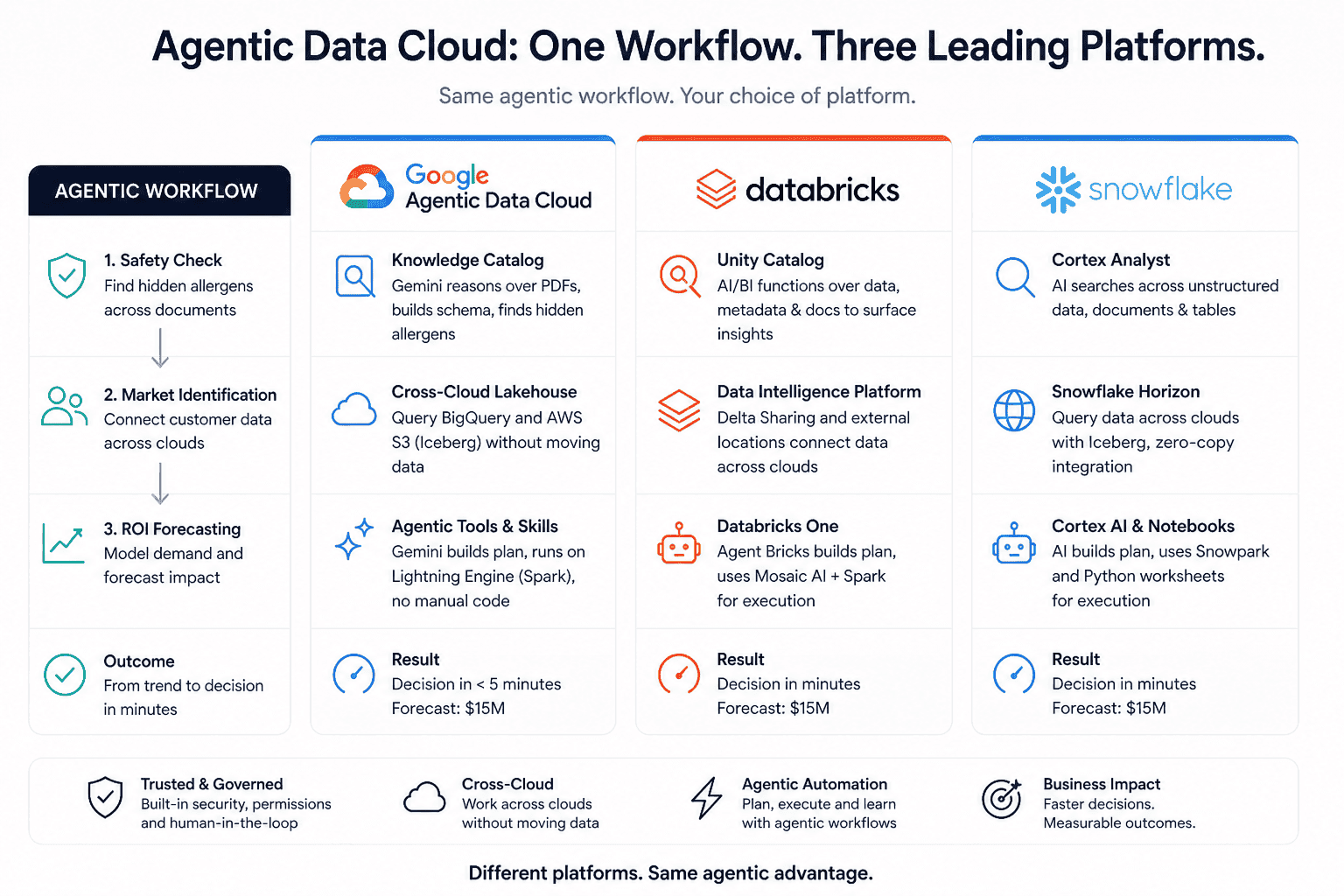
A pure cloud data warehouse that runs on AWS, Azure, or Google Cloud. Strong separation of storage and compute. Each workload runs in its own virtual warehouse, sized independently. Snowpark adds Python and Scala. Cortex adds LLM functions and natural language query through Cortex Analyst. Polaris is the Iceberg catalog play. Snowflake stays close to its core: a managed warehouse that is easy to operate.
Build and run governed AI systems
We turn your data into measurable outcomes you can track and act on.
Databricks
A lakehouse built on Apache Spark with a proprietary Photon engine, Delta Lake for ACID storage, and Unity Catalog for governance. Multi cloud across AWS, Azure, and Google Cloud. Mosaic AI handles model training and inference. AI/BI Genie provides natural language query on the semantic layer. Databricks rewards engineering teams comfortable with Spark, notebooks, and code first workflows.
Google Agentic Data Cloud
Google Cloud's umbrella name for the bundle of BigQuery, Vertex AI, Gemini, Knowledge Catalog (formerly Dataplex), Looker, BigLake, and Iceberg. The pitch: agents observe, decide, and act on data autonomously. AI in SQL functions like AI.PARSE_DOCUMENT and ML.GENERATE_TEXT live inside BigQuery itself. The platform is GCP only, with cross cloud federation as the interop layer.
The fundamental philosophical difference
Each platform embodies a different belief about how data work should happen. This is the most important thing to understand before comparing features or pricing.
Snowflake's bet
Operational simplicity wins. Most companies do not need lakehouses, Spark, or agent autonomy. They need a fast, reliable warehouse that any analyst can query. Make the platform easy to operate and let customers add complexity only when they truly need it.
Databricks's bet
Engineering control wins. Skilled engineers using medallion architecture, Delta Lake, and Spark will outperform any auto generated pipeline at scale. The platform should give them powerful tools and trust them to use those tools well.
Google's bet
Agents win. Most data work is repetitive enough that autonomous systems can handle it with the right orchestration and AI integration. Bake autonomy directly into the platform layer instead of leaving it to bolt on products.
All three bets are defensible. The right one for you depends on your team, your workload, and your appetite for engineering investment.
Pricing models compared
The single most important question is not how much each platform costs, but how each one charges. The structure of the pricing model determines which workloads will be expensive.
Snowflake
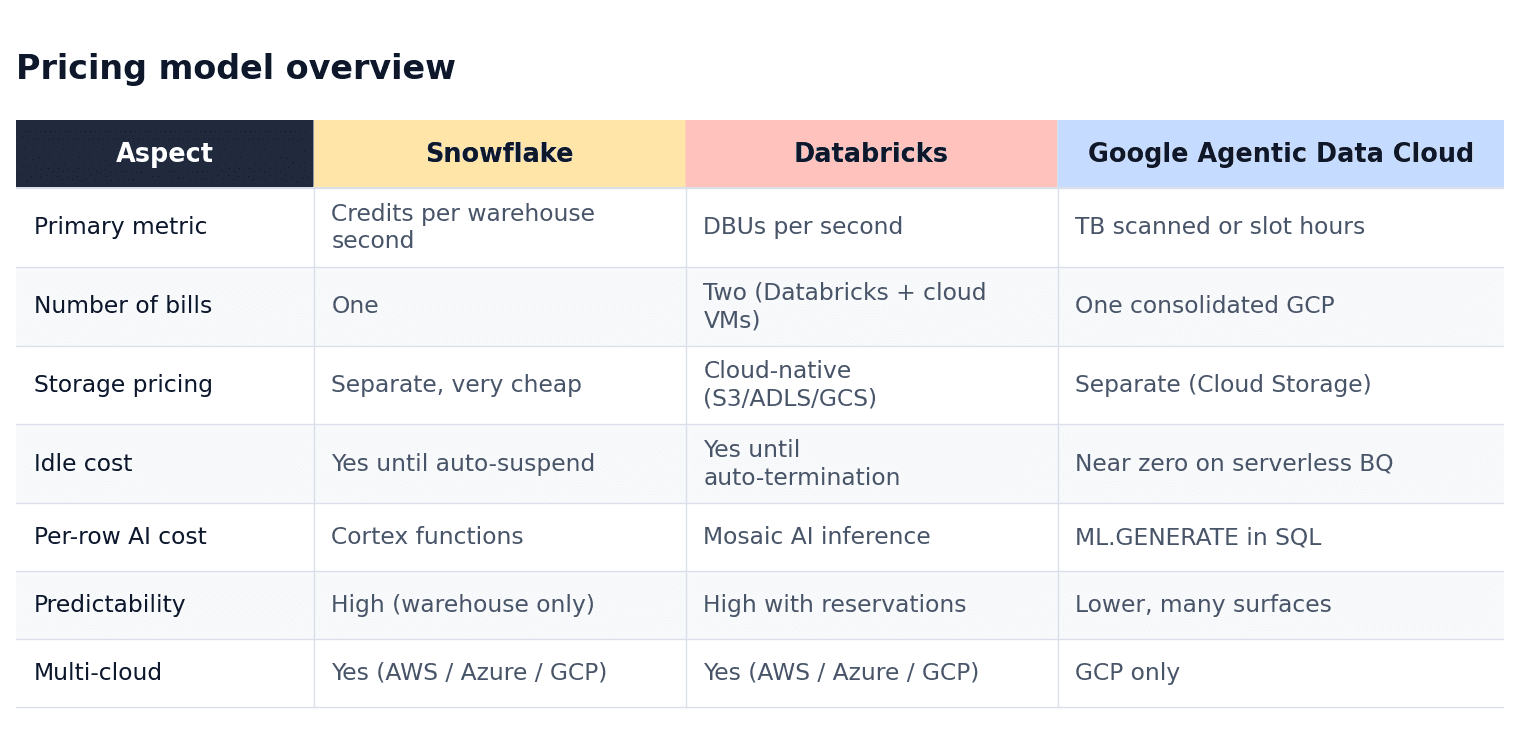
Credit-based. Each running virtual warehouse consumes credits per second, with a 60-second minimum charge after auto-suspend. Storage is separate and very cheap. Editions (Standard, Enterprise, Business Critical, VPS) multiply the credit rate. One bill, predictable for warehouse only workloads, less predictable when Snowpark and Cortex enter the picture.
Databricks
DBU (Databricks Units) per second of compute. Different SKUs (Jobs, All Purpose, SQL Pro, SQL Serverless, ML Runtime) carry different DBU rates. Photon adds a multiplier on top. The cloud VMs running underneath are billed separately by AWS, Azure, or GCP. Two bills, often surprising customers when the cloud invoice equals or exceeds the Databricks invoice.
Google Agentic Data Cloud
Multiple billing surfaces. BigQuery on demand charges per terabyte scanned. BigQuery Editions charges per slot hour. Storage is separate. Vertex AI agents and Gemini calls are per token. AI in SQL functions like AI.PARSE_DOCUMENT charge per row. Knowledge Catalog profiling charges per DCU hour. One consolidated GCP bill with many line items, easy to under estimate.
Quick pricing comparison
- Primary metric: Snowflake bills time per warehouse, Databricks bills time per compute, Google bills volume per scan or per token.
- Number of bills: Snowflake one, Databricks two (Databricks plus cloud VMs), Google one consolidated.
- Predictability: Snowflake highest for warehouse only workloads, Databricks high with reservations, Google lowest because of per unit billing surfaces.
- Idle cost: Snowflake yes until auto suspend, Databricks yes until auto termination, Google near zero on serverless BigQuery.
- Per row AI cost: Snowflake via Cortex functions, Databricks via Mosaic AI inference, Google via ML.GENERATE in SQL.
Hidden cost traps in each platform
Both buyers and engineering teams routinely under estimate these. They are the things that turn a planned $20K monthly budget into a real $40K bill.
Snowflake traps
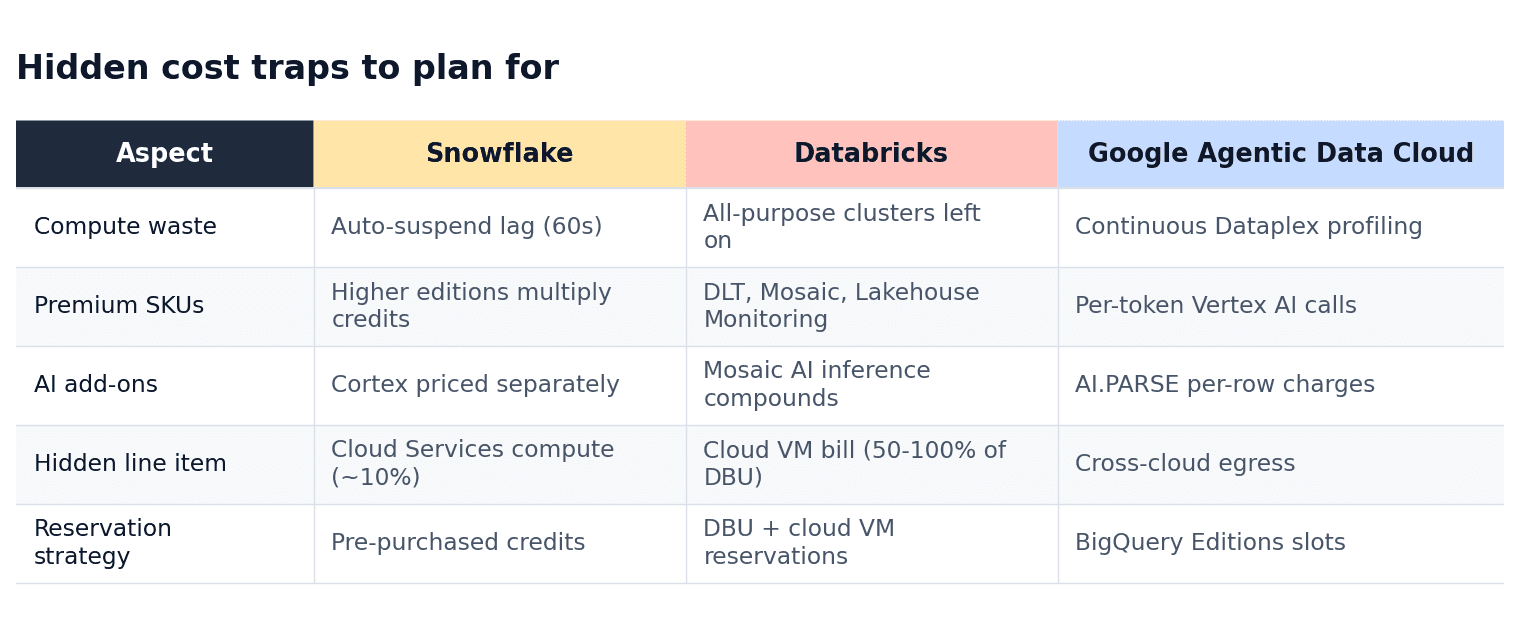
- Credit consumption spirals from a runaway query or wrong warehouse size.
- Auto suspend lag (default 60 seconds) charges separately for many short queries.
- Cloud Services compute (around 10 percent of warehouse credits) is hidden but billed.
- Automatic table reclustering consumes credits silently.
- Higher editions can multiply credit cost by 2x or 3x for the same workload.
- Snowpark, Cortex, and ML add ons priced separately, often expensively.
Databricks traps
- Two bill surprise: cloud VM cost is often 50 to 100 percent of DBU cost.
- All Purpose clusters left running by developers overnight.
- Photon premium enabled on workloads that do not benefit from vectorised execution.
- Premium SKUs (DLT, Mosaic, Lakehouse Monitoring) compound fast.
- No autoscaling configured properly leads to paying for max capacity at 10 percent utilisation.
Google Agentic Data Cloud traps
- Continuous Knowledge Catalog profiling on every table by default.
- AI in SQL functions on large row counts produce five figure single queries.
- Agents that retry on failure consume the full token cost on each retry.
- On demand BigQuery without reservations becomes expensive at scale.
- Cross cloud federation egress charges if reading from AWS or Azure data.
Where each one wins
Snowflake wins for
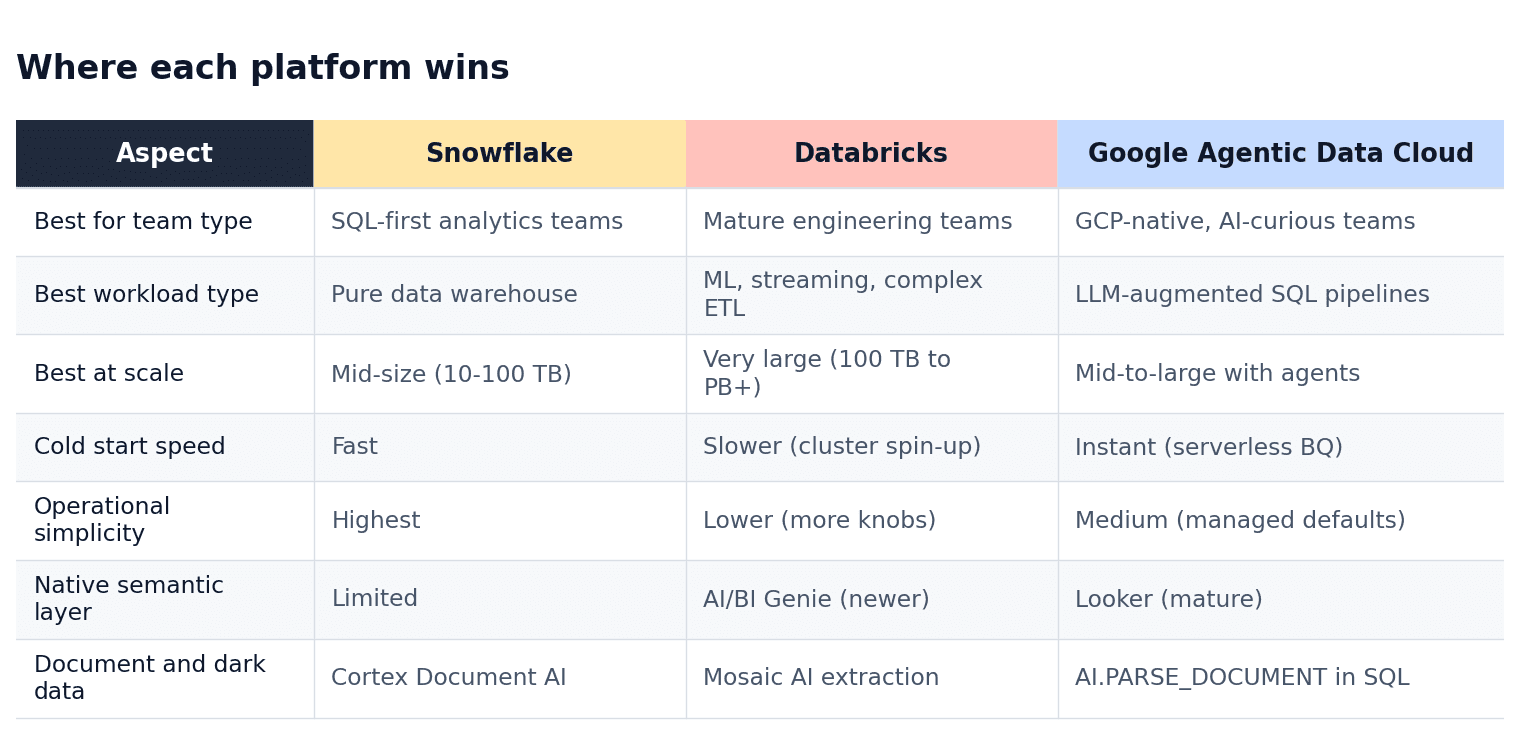
- Pure SQL analytics teams that want operational simplicity over engineering depth.
- Mid size companies (10 to 100 TB) where the credit model and auto suspend keep costs predictable.
- Multi cloud organisations that need the same warehouse experience across AWS, Azure, and GCP.
- Teams that prioritise short cold start times and per second billing for ad hoc queries.
- Buyers who value a smaller learning curve and clean separation of storage from compute.
Databricks wins for
- Mature engineering teams that already know Spark and want full control over pipelines.
- Heavy ML and data science workloads, including GPU training and model lifecycle management.
- Real time streaming pipelines built on Structured Streaming or Delta Live Tables.
- Large scale ETL with complex Python transformations that exceed what SQL can express cleanly.
- Lakehouse architectures using Delta Lake (or Iceberg via Tabular) as the canonical storage layer.
- Multi cloud organisations that want a single platform across AWS, Azure, and GCP.
Google Agentic Data Cloud wins for
- GCP native organisations that want one consolidated platform for warehouse, ML, and BI.
- Teams that want LLM functions inside SQL without managing a separate inference layer.
- Workloads heavy on operational data sources (AlloyDB, Cloud SQL, Spanner) that benefit from zero ETL replication.
- Companies betting on autonomous agents driving data pipelines rather than human written code.
- Document heavy use cases where AI.PARSE_DOCUMENT replaces a custom OCR and extraction pipeline.
- Buyers who want continuous data profiling and lineage as part of the platform on day one.
Where each one falls short
This is the section every comparison post avoids. It matters more than the strengths.
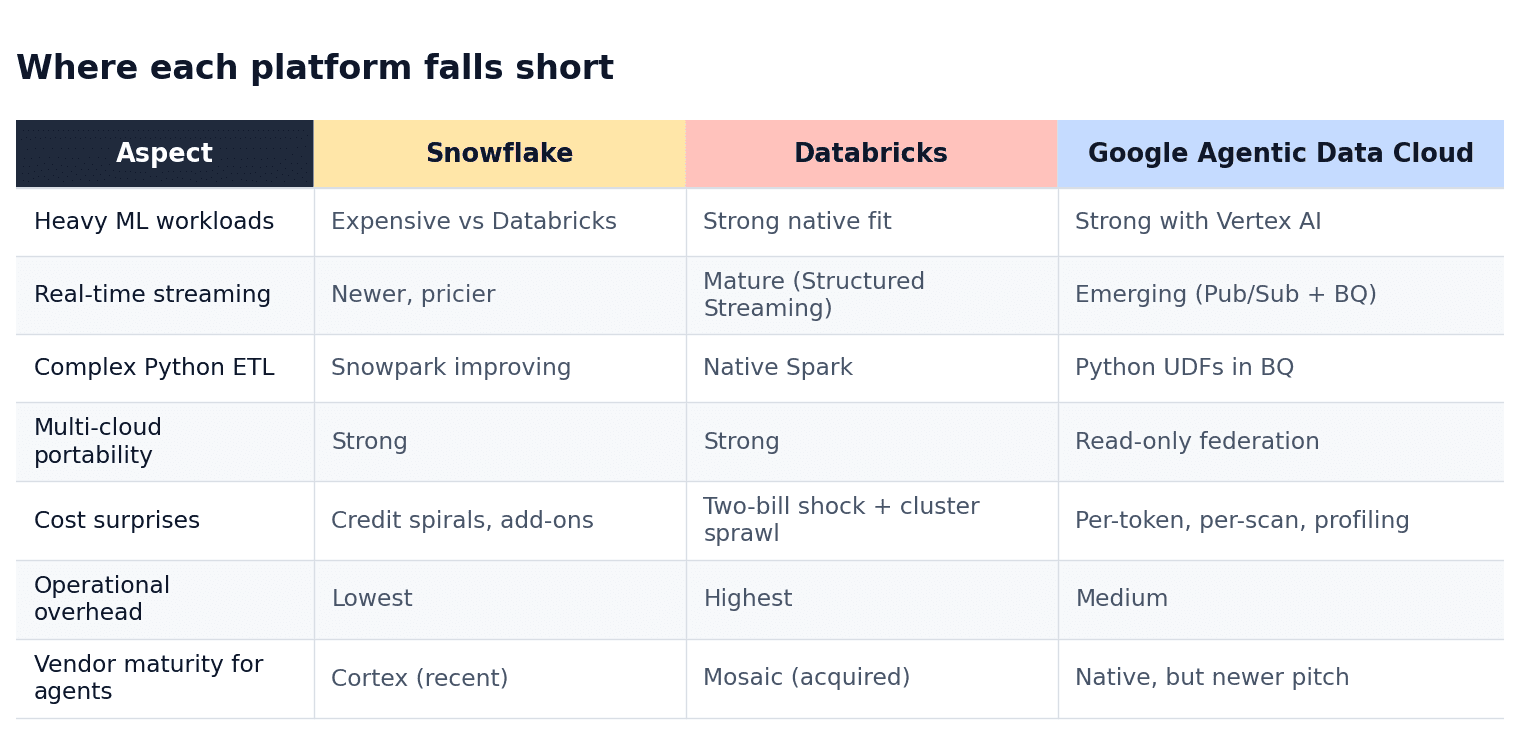
Snowflake's gaps
- Heavy ML workloads are expensive compared to Databricks. Snowpark and Cortex are improving but not at parity.
- Streaming is newer and pricier than Databricks Structured Streaming.
- Complex ETL in Python often runs better on Spark than on Snowpark.
- Storage egress to use data outside the warehouse can be costly.
- Cortex Analyst (natural language query) is a recent entrant and lacks the maturity of Looker.
Databricks's gaps
- Operational complexity is higher than Snowflake. Cluster sizing, autoscaling, and Photon decisions need engineering attention.
- The two bill surprise (Databricks invoice plus cloud VMs) consistently catches customers off guard.
- Notebooks can become hard to maintain at scale without strong engineering discipline.
- AI/BI Genie is newer than Looker and has fewer years of LookML style semantic modelling behind it.
- Smaller workloads can struggle to justify the platform overhead.
Google Agentic Data Cloud's gaps
- GCP only. Cross cloud federation is read interop, not portability.
- Continuous Knowledge Catalog profiling can become a meaningful cost line on large warehouses.
- Per token Vertex AI and per row AI in SQL costs can spiral on heavy workloads without proper controls.
- Agents are confident but not always correct. Human review and guardrails are still required for production.
- The agentic narrative is newer than Snowflake and Databricks pitches, with less production evidence at enterprise scale.
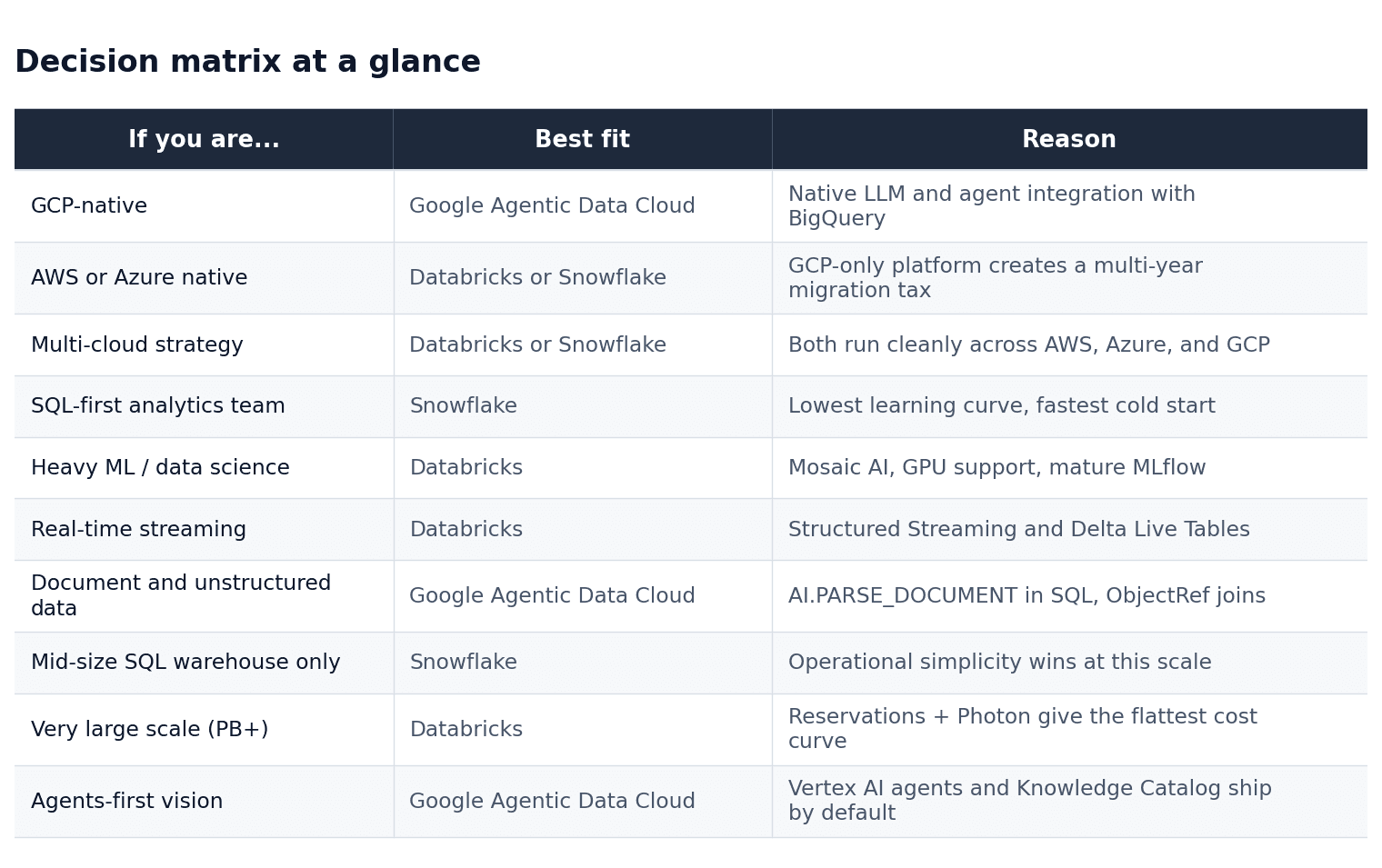
The decision matrix: which platform fits which workload
These are the angles that matter most when picking a platform. Use them in this order: existing cloud commitment, then workload type, then team profile, then data scale, then cost predictability needs.
By data volume
- Under 10 TB: Snowflake or Google Agentic Data Cloud win on operational simplicity. Databricks is overkill.
- 10 to 100 TB: All three are viable. Decision depends on workload mix and existing tools.
- 100 TB to 1 PB: Databricks wins on cost predictability through reservations. Snowflake is competitive with proper warehouse sizing.
- Over 1 PB: Databricks (with reservations and Photon) usually delivers the flattest cost curve. Google can match with BigQuery Editions and slot reservations.
By team profile
- One to three generalist engineers: Snowflake or Google. Operational simplicity matters more than engineering depth.
- SQL focused analytics team: Snowflake first, Google second.
- Strong Python and Spark expertise: Databricks lets you use what your team already knows.
- Heavy ML and data science: Databricks leads. Google second with Vertex AI integration.
- Mostly business analysts: Snowflake or Google with Looker for ergonomics.
- Platform and DevOps engineers: Databricks gives more control through IaC and infrastructure access.
By workload type
- Pure data warehouse: Snowflake.
- Lakehouse with ETL and ML: Databricks.
- Real time streaming: Databricks.
- Ad hoc SQL analytics: Snowflake or Google BigQuery.
- Dashboarding and BI: Snowflake (with Sigma, Tableau) or Google (Looker bundled).
- ML training and serving: Databricks first, Google second.
- LLM augmented pipelines: Google has the most ergonomic story with Gemini in SQL.
- Document extraction and unstructured data: Google with AI.PARSE_DOCUMENT, Databricks with Mosaic AI as alternative.
- Geospatial or scientific computing: Databricks with Spark library ecosystem.
By existing cloud commitment
- Already on AWS or Azure: Snowflake or Databricks. Skip Google Agentic Data Cloud unless ready for a re platform.
- Already on GCP: Google Agentic Data Cloud is the natural choice. Databricks is a reasonable alternative for ML heavy teams.
- Multi cloud strategy: Snowflake or Databricks. Both run on all three major clouds.
- Greenfield with no constraints: Decision flips to team profile and workload type.
By cost predictability needs
- Lowest entry cost: Google with BigQuery on demand.
- Most predictable monthly bill: Snowflake for warehouse only workloads, Databricks with proper reservations.
- Cheapest at very high scale: Databricks with reservations and Photon, Google with Editions.
- Best when a team cannot optimise heavily: Snowflake. Managed defaults are reasonable, fewer decisions to make.
- Easiest to budget agentic costs: None of them well. All three have token based unpredictability for AI workloads.
Common mistakes when choosing
Mistake one: picking on price alone
All three platforms cost roughly the same total ownership over three years for similar workloads. Discipline of operation matters more than headline pricing. A poorly run Snowflake costs more than a well run Databricks, and vice versa.
Mistake two: assuming agentic features replace engineers
Agents are good at writing first draft code. They are bad at understanding business semantics, distinguishing expected drift from breakage, or choosing when to use streaming versus batch. Skilled engineers are still required across all three platforms.
Mistake three: ignoring cloud commitment
Picking Google Agentic Data Cloud when most of your team and data already live on AWS creates a multi year platform tax. The same applies in reverse. Cloud commitment is the strongest gravity in this decision.
Mistake four: confusing demos with production
All three vendors demo their agentic features beautifully. Production looks different. Cost surfaces show up. Drift detection without prevention causes silent dashboard corruption. Plan for the boring operational layer that no demo covers.
The honest bottom line
Strip all the noise away and the recommendations look like this:
- If you are GCP native and want one consolidated platform with strong AI integration: Google Agentic Data Cloud is the natural fit, with the cost controls and governance design done properly.
- If you are multi cloud or AWS or Azure based with mature engineering: Databricks gives you the most control and the flattest cost curve at scale.
- If you are SQL focused and value operational simplicity: Snowflake remains the easiest platform to operate, especially for teams under pressure to ship fast.
- If your workload is heavy on ML, streaming, or complex ETL: Databricks regardless of cloud.
- If your workload is heavy on document extraction and natural language analytics: Google Agentic Data Cloud, with budget caps in place from day one.
None of these recommendations is permanent. Workloads change, teams change, and the agentic features in all three platforms are evolving fast. Revisit the decision every 18 to 24 months.
How we help
Muoro engineers ship across all three platforms in production. We help teams choose the right one for their workload, design the cost controls and governance policies before any agent goes live, and embed with the team for the implementation.
If you are evaluating Google Agentic Data Cloud specifically, our standalone Agentic Data Cloud capability page walks through the components, costs, and how we work with teams adopting it.
If you would prefer a working session, book a 30 minute call with our team.
Start your project with Muoro!
Fill out the form and our business team will reach out to you within 24 hours.
Similar Blog Posts
Similar Blog Posts


Start Building Data-First Production AI
Move beyond pilots. Build AI systems that drive real decisions and measurable outcomes.
TALK TO US